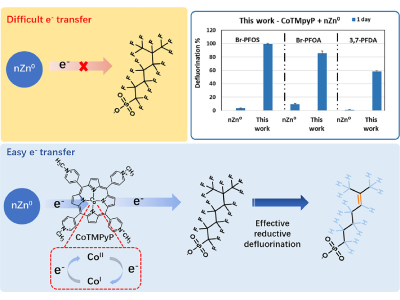
Credit: Jun Sun et al.
A team of researchers from UNSW's School of Chemistry has developed a novel system to break down branched PFAS. The method could provide remediation experts with a more efficient and sustainable tool for PFAS remediation worldwide.
PFAS are notoriously resistant to degradation due to their stable structure. This chemical stability has led to a lack of efficient and scalable remediation processes. The catalyst system created by the team, published in Water Research, presents a promising alternative to current remediation methods.
"Owing to its robust nature, simple application, and cost effectiveness, the new system we have developed shows successful PFAS remediation in the lab, which we hope to eventually test at a larger scale," said Jun Sun, first author of the paper.
The system relies on Nano zero-valent metals (nZVMs) which have seen extensive use for decades for the treatment of groundwater and soil contaminated with chlorinated compounds. Previous research has indicated that PFAS can be degraded using nZVMs in combination with vitamin B12, however, that degradation was slow and inefficient.
"Inspired by the fact that B12 has the potential to catalyze this reaction, we wanted to synthesize a catalyst that mirrors the unique ring shape of B12, which we did using a structure known as a porphyrin ring," said Sun.
To test the system, the researchers mixed PFOS and PFOA with nZVMs and the porphyrin ring and measured the degradation of the PFAS. "We did this by following how much fluoride is released as those strong carbon-fluoride bonds are broken down," said Sun. "So by simply measuring the amount of fluoride ion that is produced by the reaction, we can tell how much of the PFAS have been degraded.
We also compared these results to the existing B12 catalysts and found that the cobalt porphyrin ring we have used was more efficient and faster at degrading branched PFAS."
The system developed resulted in 75% of the fluoride being released within five hours. "The next step for us is to really try this on a pilot scale to see if this can be done out of the laboratory on a real sample," said Naresh Kumar. "Then we'd like to try it out in a real water purification system or sites which are contaminated with PFAS."