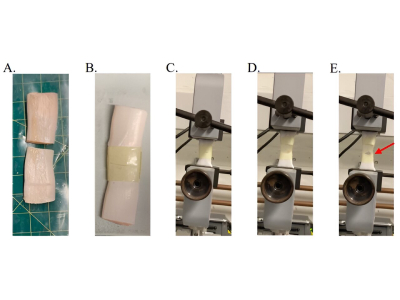
Investigation of adhesion property of αLA-MS4 patch + αLA-MS2 spray combination on bovine tendon. Credit: Subhajit Pal et al.
Bioengineers from the University of California, Berkeley have developed a new environmentally friendly adhesive polymer. The polymer demonstrated similar strength as those derived from petroleum-based products.
Published in Science, the adhesive developed utilizes an electrophilic stabilizer to prevent fatty acid depolymerization to enable it to be used as an adhesive. In an additional article published by the researchers, the team points out that while polymer adhesives are used for a variety of applications, most are tailored for a specific use.
The researchers set out to develop a sustainable polymer adhesive that could be used for a variety of applications, both medical and non-medical.
Turning to polymers derived from α-lipoic acid (αLA), the team found that the addition of an electrophilic stabilizer could stop the polymer from breaking down. This stabilization allowed for the creation of a whole family of adhesives that could be broken down when desired.
During analysis, the team found the new adhesives effective when used with wood, metal, and tissue mending. Additionally, they discovered that one of their pressure-sensitive adhesives had 10 times the peel strength of commercially available products and it worked in wet or dry conditions.
In addition to developing the family of adhesives, the team also developed a closed-loop recycling process that allows for the creation of new adhesives from old recycled ones.