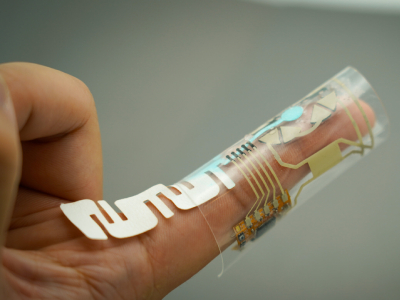
This finger wrap is powered by the wearer's fingertip sweat—and also monitors levels of glucose, lactate, vitamin C and levodopa in that same sweat. Credit: Shichao Ding
UC San Diego engineers have developed a novel wearable device to perform continuous personalized health monitoring. The device monitors the sweat on a patient's fingertip to analyze levels of critical biomarkers such as glucose, vitamins, and others.
In the research, published in Nature Electronics, the team developed a device that snugly wraps around the finger and draws power from the sweat on the fingertip. Fingertips can contain over one thousand sweat glands, providing a reliable energy source without the need for external stimuli.
The device is comprised of electronic components printed onto a thin and flexible polymer. The design of the device allows for it to be easily shaped to the finger while being durable enough to withstand the constant bending and movement of the finger.
"It is based on a remarkable integration of energy harvesting and storage components, with multiple biosensors in a fluidic microchannel, along with the corresponding electronic controller, all at the fingertip," said Joseph Wang, professor in the Department of Chemical and Nano Engineering at UC San Diego.
While the device is worn, sweat is wicked through microfluidic channels to analyze biomarker levels while also drawing the energy it needs to continue operating. To process the signals from the sensors, a small chip is embedded that wirelessly transmits data via Bluetooth.
"This is automatic health monitoring at your fingertips," said Shichao Ding, a postdoctoral researcher in Wang's research group. "The wearer can be resting or asleep, and the device can still harvest energy and track biomarker levels."
During testing, the device was worn throughout the day and successfully tracked and monitored glucose, lactate, vitamin C, and levodopa levels. The device can also be tailored to an individual's health needs by selecting different biomarkers.
The team plans to develop a closed-loop system using the device to not only monitor biomarkers but also administer treatment based on the data collected.
"Autonomous power, sensing and treatment all in one device—that's the ultimate goal," said Ding.