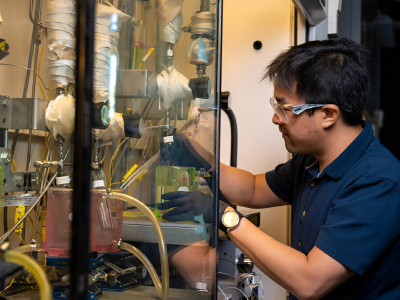
Daniel Santosa, a Washington State University doctoral student and scientist at Pacific Northwest National Laboratory, tests a WSU-developed continuous process that turns lignin, a polymer found in plants, into jet fuel. Credit: Washington State University
Scientists from Washington State University have developed a novel method to produce jet fuel from lignin-based agricultural waste sustainably. Produced with a technique that directly converts the lignin into fuel, the team's method could improve sustainable aviation fuel performance.
The research, published in Fuel Processing Technology, describes a process dubbed "simultaneous depolymerization and hydrodeoxygenation" by the team of researchers. During simultaneous depolymerization and hydrodeoxygenation, lignin polymers are broken down while removing oxygen. The dissolved lignin polymer is introduced to a continuous hydrotreating reactor, resulting in jet fuel.
"Our achievement takes this technology one step closer to real-world use by providing data that lets us better gauge its feasibility for commercial aviation," said Bin Yang, professor in WSU's Department of Biological Systems Engineering.
The research was the first successful test of a continuous process, demonstrating the scalability of fuel production for commercial use.
"The aviation enterprise is looking to generate 100% renewable aviation fuel," said Josh Heyne, research team member and co-director of the WSU-PNNL Bioproducts Institute. "Lignin-based jet fuel complements existing technologies by, for example, increasing the density of fuel blends."
Lignin-based fuels help to reduce emissions while being drop-in capable, meaning they are fully compatible with existing engines and infrastructure.
"We're working to create an effective, commercially relevant technology for a complementary blend component that can achieve the 100% drop-in goal," added Heyne.