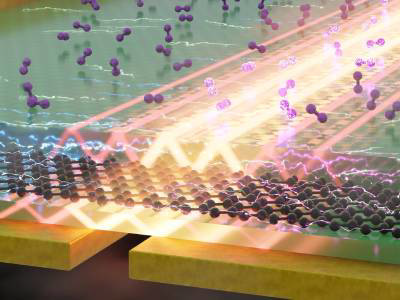
Illustration of an on-chip molecular vibration sensor based on a graphene IR detector, where phonon polaritons (bright rays) enhance the molecular fingerprint signal encoded in the photocurrent. Credit: Dr. David Alcaraz, ICFO
Researchers have developed a novel on-chip device that can use a molecule's infrared vibrational "fingerprint" to identify it. The innovative technology relies on the conversion of incident infrared light into ultra-confined "nanolight" within the detector's active area which boosts sensitivity making the molecular fingerprint easier to analyze.
When illuminated with the correct light, molecules vibrate at a characteristic frequency and strength giving them a sort of fingerprint. Similar to human fingerprints, this information can be exploited to differentiate between types of molecules and gasses. Traditionally this work is done with infrared fingerprint spectroscopy, however, organic molecules have proven difficult to detect due to their weak scattering signal.
In recent years, researchers have addressed this shortcoming with the development of Surface-Enhanced Infrared Absorption (SEIRA) spectroscopy which leverages the infrared enhancements provided by metallic nanostructures to amplify molecular signals. Recently, to further boost molecular signals, phonon polaritons such as hyperbolic phonon polaritons in thin layers of hexagonal boron nitride (h-BN) have emerged as candidates for boosting SEIRA spectroscopy sensitivity.
In their work, published in Nature, a team of researchers combined the two processes resulting in the first on-chip phononic SEIRA detection of molecular vibrations. By employing ultra-confined HPhPs in nanometer-thin layers directly in the photocurrent of a graphene-based detector, the team eliminated the need for bulky IR detectors while maintaining the ability to detect molecular fingerprints.
"One of the most exciting aspects of this approach is that this graphene-based detector opens the way towards miniaturization," said Dr. Sebastián Castilla, an ICFO researcher. "By integrating this detector with microfluidic channels, we could create a true 'lab-on-a-chip,' capable of identifying specific molecules in small liquid samples—paving the way for medical diagnostics and environmental monitoring."
"On-chip infrared detectors operating at room temperature could enable rapid molecular identification, potentially integrated into smartphones or wearable electronics," added Dr. Andrei Bylinkin, Nanogune researcher. "This would offer a platform for compact sensitive, room-temperature infrared spectroscopy."