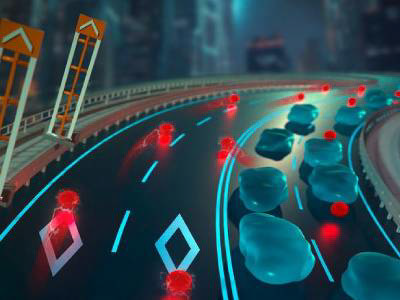
Record ion speeds are achieved in organic conductors where local molecules can attract or repel ions from nanochannels that act as ion superhighways. Credit: Second Bay Studios
Washington State University and Lawrence Berkeley National Laboratory researchers have broken a speed record that could lead to advances in applications such as battery charging and biosensing.
The research, published in Advanced Materials, accelerates ion movement in mixed organic ion-electronic conductors by using molecules to attract and concentrate ions into nanochannels.
“Being able to control these signals that life uses all the time in a way that we've never been able to do is pretty powerful,” said Brian Collins, WSU physicist. “This acceleration could also have benefits for energy storage, which could be a big impact.”
While these kinds of conductors hold great potential thanks to moving ions and electrons simultaneously, how they coordinate this movement has not been well understood. As part of their study, the team observed that ions moved through the conductor slowly, and because of their coordinated movement, the electrical current was also slow.
“We found that the ions that were flowing all right in the conductor, but they had to go through this matrix, like a rat's nest of pipelines for electrons to flow. That was slowing down the ions,” Collins said.
To remedy this, the team devised a nanometer-sized channel lined with hydrophilic molecules to attract ions where they could move separately. They found that once in the channel the ions moved at speeds more than ten times faster than through water alone, representing a new world record for ion speed in any material.
Additionally, the team developed a chemical reaction system to flip the molecules' attractiveness to the electrolyte, providing a means to control access through the cell walls. With this, a sensor could be utilized to detect a chemical reaction near the channel providing a detection ability at the nanoscale which could have widespread environmental or life science applications.
“The next step is really to learn all the fundamental mechanisms of how to control this ion movement and bring this new phenomenon to technology in a variety of ways,” Collins concluded.