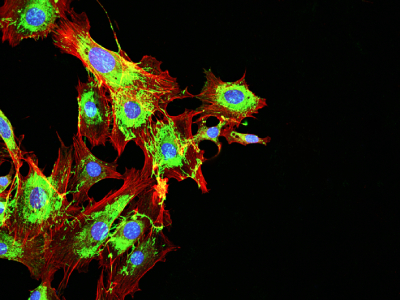
Osaka university researchers have developed a novel microscope that achieves high resolution Raman imaging of biological samples.
Raman microscopy could be a very useful technique for biological sample imaging by providing chemical information for specific molecules. However, current Raman techniques are limited since the Raman light coming from biological samples is very weak and often swamped by background noise.
In the research, published in the journal Science Advances, the researchers developed a new microscope capable of maintaining the temperature of previously frozen samples during image acquisition. By maintaining the temperature of the sample, the microscope can produce images up to eight times brighter than previous Raman microscopes.
"One of the main reasons for blurry images is the motion of the things you're trying to look at," said Kenta Mizushima, the lead author of the study. "By imaging frozen samples that were unable to move, we could use longer exposure times without damaging the samples. This led to high signals compared with the background, high resolution, and larger fields of view."
Additionally, the freezing process does not rely on stains or chemicals to fix cells in position and preserves the physicochemical states of various proteins, giving the cryofixing approach a distinct advantage when compared with other chemical fixing methods.
"Raman microscopy adds a complementary option to the imaging toolbox," says senior author Katsumasa Fujita. "The fact that it not only provides cell images, but also information about the distribution and particular chemical states of molecules, is very useful when we are continually striving to achieve the most detailed possible understanding."