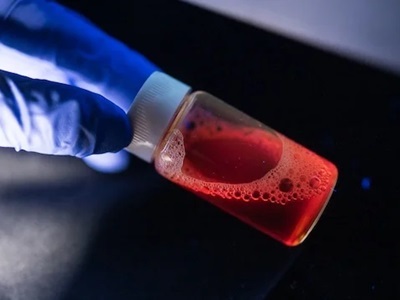
The new micellar technology represents a step forward in sustainable chemistry. Photo by Jeff Fitlow/Rice University.
Researchers at Rice University have developed a new method for performing chemical reactions using water instead of toxic solvents. The scientists created microscopic reactors capable of driving light-powered chemical processes by designing metal complex surfactants (MeCSs) that self-assemble into nanoscale spheres, called micelles.
This innovation could drastically reduce pollution in industries including pharmaceuticals and materials science, where harmful organic solvents are often necessary.
In their study, the researchers tested different versions of the MeCSs by altering the length of their hydrophobic tails. They found that these molecules could form micelles as small as 5-6 nanometers, much smaller than those in similar systems. The team used these micelles to perform a photocatalytic reaction, achieving high yields without needing harmful solvents.
“These micelles act like tiny reaction vessels,” said Ying Chen, first author of this study and a doctoral student in chemistry at Rice. “They enable chemical transformations that wouldn’t normally work in water while being more sustainable than traditional methods.”
Many chemical processes in manufacturing and research rely on organic solvents, which are harmful to the environment and expensive to handle safely. The development of photoactive water-based micelles capable of driving chemical reactions offers a safer, greener alternative. Additionally, the system can be reused, improving its cost-effectiveness and environmental footprint.
Information courtesy of Rice University