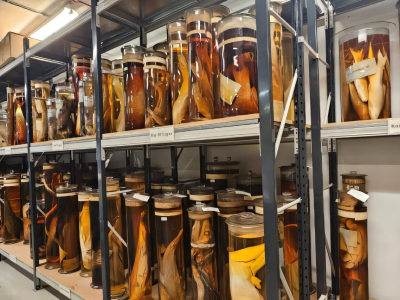
Historic specimens preserved in jars at the Natural History Museum. Credit: Sara Mosca, STFC
Researchers have developed a novel technique based on Spatially Offset Raman Spectroscopy (SORS) to provide a non-invasive method to identify the chemical composition of the preservation fluids found in historic jars.
The method, published in ACS Omega, utilizes a handheld Spatially Offset Raman Spectroscopy (SORS) device to analyze the chemical composition through their original glass containers without opening them, helping to prevent compromising the specimens within. SORS accomplishes this analysis by analyzing the changes in wavelength that occur when light is reflected after shining a laser into a container.
The results of the study demonstrate the efficacy of using SORS to conduct non-invasive analysis of preservation fluids, a task which has proven challenging for traditional methods. In their work the team demonstrated that SORS can not only identify the dominant substances in the preservation fluid, but also differentiate the concentration points of components in water within the same preservation fluid.
"After many years of seeking an appropriate analytical approach, it is exciting to be part of this enthusiastic project," concluded Chelsea McKibbin, senior conservator at London's Natural History Museum.
The technique developed could prove invaluable for non-invasive analysis of historic specimens and could aid in developing more informed care for them.