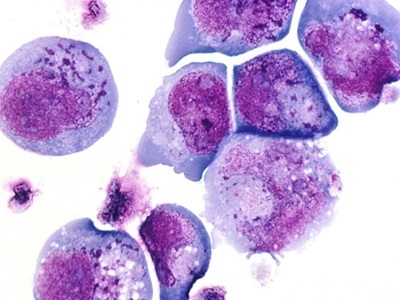
Credit: NIH/NIAID
A new combination of microscopy methods has revealed exquisite detail of the virus assembly process used by herpes simplex virus during replication.
HSV-1 is a large virus that infects the mucous membranes of the mouth and genitals, causing life-long latent infections. The virus is composed of three layers—a capsid that contains the viral DNA, a protein layer called the tegument and an outer envelope that is studded with viral glycoproteins. During replication, newly copied viral genomes are packaged up into this three-layer structure in a process called viral assembly.
Viral assembly itself involves a multi-step process, starting in the cell’s nucleus with assembly of capsids, packaging of the DNA to form “nucleocapsids,” and transport of these nucleocapsids out of the nucleus via a process of primary envelopment and de-envelopment to travel across the nuclear envelope. This is followed by a secondary envelopment in the cellular area surrounding the nucleus, called the cytoplasm (cytoplasmic envelopment).
The study authors used an emerging 3D imaging approach to examine the envelopment mechanism. The approach combined two methods—cryo-structured illumination microscopy (cryoSIM) to detect fluorescently labeled capsid or envelope components, and cryo-soft-X-ray tomography (cryoSXT) to identify the cellular substructure in the same infected cells.
The method was successful in identifying specific structural components within the viral assembly process, allowing the team to visualize exactly where the assembly process stalls for each mutant virus, and providing insights into the unmutated gene’s usual role in viral assembly.
The authors captured different assembly stages during cytoplasmic envelopment using their mutant viruses and showed that—contrary to previous theories—cytoplasmic envelopment is caused by the budding of a capsid into an intracellular membrane vesicle, and not by the capsid being wrapped by the vesicle membrane.
The team also discovered that this budding is asymmetric; they observed several instances of stalled viral assembly where groups of capsids were gathered at one region, or side, of a spherical vesicle.
Research like this that provides a deeper understanding of the viral assembly process could inform the design of novel treatments or cures that inhibit virus formation.
Information provided by eLife