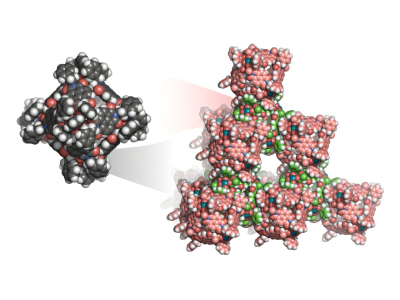
Crystal structure of van der Waals open framework-1 (WaaF-1). Credit: Kyoto University iCeMS
Kyoto University researchers have made a significant advancement in materials science through the development of the world’s first three-dimensional van der Waals open frameworks (WaaFs), directly challenging the long-standing belief that van der Waals interactions are too weak to support open framework materials.
Their findings, published in Nature Chemistry, present octahedral metal-organic polyhedra (MOPs) as building blocks for WaaFs which exhibit excellent thermal stability, porosity, and reversible assembly.
Despite previous belief that van der Waals interactions would be too weak to form robust frameworks, WaaFs maintain their integrity up to 593 K with surface areas exceeding 2,000 m2/g, making them highly stable and efficient for several industrial applications.
"Our research challenges the long-standing assumption that van der Waals forces are too weak to construct stable frameworks. Through careful supramolecular design, we have demonstrated that these interactions can be harnessed to create robust and highly porous materials with practical applications," said Professor Shuhei Furukawa of Kyoto University's Institute for Integrated Cell-Material Sciences (iCeMS).
"This discovery redefines the design principles of porous materials, showcasing a new approach to material engineering that enables both scalability and recyclability. WaaFs offer an innovative solution for gas separation, storage, and beyond," Shun Tokuda, concluded lead researcher of the study.