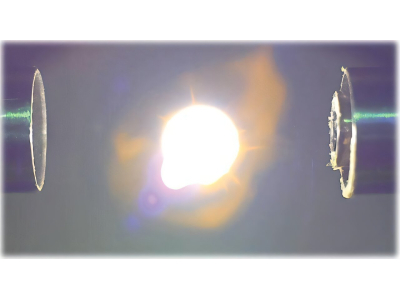
LIBS plasma of molten salt aerosols is formed from a sparging salt vessel. Credit: Zechariah Kitzhaber/ORNL, U.S. Dept. of Energy
Oak Ridge National Laboratory researchers have developed a novel laser-induced breakdown spectroscopy technique to track chemical changes in molten salt in real time, helping provide new insights into molten salt reactors.
Molten salt reactors have experienced renewed interest as a potential energy production source over the last few years. Within a molten salt reactor, salt is heated above its melting point before being used to dissolve uranium generating a mixture that acts as both coolant and fuel inside the reactor. Despite their relative efficiency and safety, the complex chemical makeup required to operate them demands novel sensing technologies to monitor the chemical state of the reactor.
In their work, published in the Journal of the American Chemical Society, the researchers describe their use of laser-induced breakdown spectroscopy (LIBS) to provide real time measurements of the elemental and isotopic makeup of molten salt for the first time. In this use case, the team of researchers utilized a LIBS platform which allowed several spectrometers to capture data simultaneously.
"LIBS has been used before for investigating the elemental composition of solid samples like plant roots, solid nuclear fuel and geological samples; however, these samples do not change in time," said ORNL staff scientist Hunter Andrews. "Here, we wanted to demonstrate the combined elemental and isotopic power of LIBS and harness its rapid measurement speed on the scale of milliseconds."
while molten salt reactors are most known for their efficient electricity production, they also provide the opportunity to harvest radioisotopes during operation. The LIBS method developed by the team will allow future researchers to quantify and identify these radioisotopes in real time within the molten salt mixture.