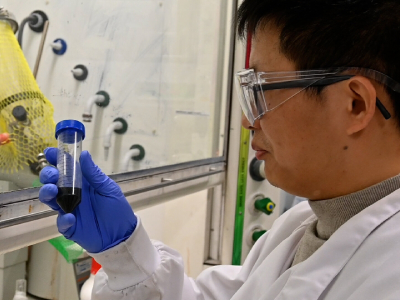
Dr. Long Yang extracting the fluorine content from degraded PFAS materials (photographed in Oxford's Chemistry Research Laboratory). Credit: Department of Chemistry, University of Oxford.
University of Oxford chemists have developed a novel technique which destroys fluorine-containing PFAS compounds while recovering the fluorine molecules for future use.
The method, published in Nature, reacts PFAS samples with potassium phosphate salts before grinding the sample with ball bearings. This reaction and mechanical destruction break down the PFAS while allowing fluorine to be extracted. During testing the researchers used the recovered fluorine to generate fluorinating reagents commonly used for industrial reactions.
The method has proven effective for mechanical destruction of all PFAS classes including those found in common products such as non-stick coatings and industrial supplies.
The recovery of fluorine from PFAS molecules will aid future efforts to establish a circular fluorochemical industry, an effort that is becoming more essential as fluorochemical production becomes increasingly critical for worldwide industrial processes. Additionally, the phosphate used can also be recovered and reused for PFAS destruction.
"Fluoride recovery is important because our reserves of Fluorspar, essential for the manufacturing of e.g. life-saving medicines, are rapidly depleting due to extensive mining," said Véronique Gouverneur Professor at University of Oxford. "This method not only eliminates PFAS waste but also contributes to a circular fluorine chemistry by transforming persistent pollutants into valuable fluorochemicals."
"The mechanochemical destruction of PFAS with phosphate salts is an exciting innovation, offering a simple yet powerful solution to a long-standing environmental challenge. With this effective PFAS destruction method, we hope to shift away from the notion of PFAS as 'forever chemicals,'" added Dr. Long Yang, one of the lead authors of the study.
The method has proven effective for mechanical destruction of all PFAS classes including common products such as non-stick coatings and industrial supplies.