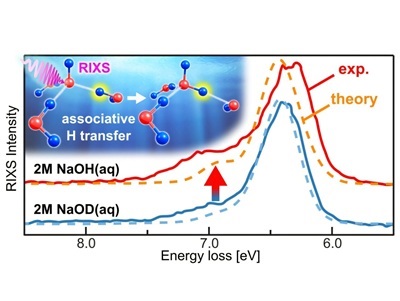
Proton attraction. Credit: Stephan Thürmer
Proton transfer in aqueous systems is a fundamental process occurring constantly around us. It involves a molecule losing a proton, which then associates with another molecule. Given its significance in fields such as electrochemistry, energy conversion and biology, scientists have been investigating its mechanisms for more than 200 years since the first model was proposed.
Now, an international team of researchers are investigating these dynamics using X-ray spectroscopy, which allows them to examine how individual atoms behave within a molecule.
In new research published in the Journal of the American Chemical Society, researchers excited the aqueous hydroxyl ion (OH−) and investigated the mechanism by which an associative state attracts a proton from neighboring water molecules. They observed a shoulder spectral feature, in addition to the strong local decay in Resonant Inelastic X-ray Scattering (RIXS)—a technique that measures the energy loss of X-rays scattered by atoms, revealing details about the molecular environment. This showed an isotope effect in aqueous OH−/OD−.
Using state-of-the-art cluster calculations, the researchers found that the smaller peak feature comes from an associative state in aqueous OH−, where a proton approaches the OH−/OD− after resonant excitation.
This new observation in the scattering process of the solvated hydroxide ion shows that nuclear dynamics in RIXS can involve associative states, in addition to the dissociative states observed in systems like water and acetic acid.
Information provided by Tohoku University