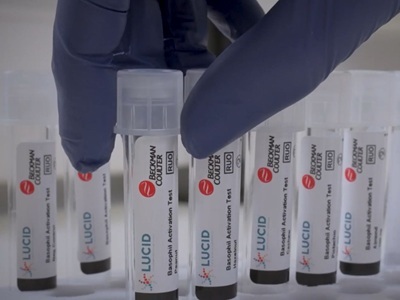
Beckman Coulter Life Sciences has introduced the next-generation Basophil Activation Test (BAT) for research use only to more effectively characterize food allergies without exposure to potentially harmful allergens.
Approximately 220 million people globally suffer from at least one food allergy. Most food allergies and treatment efficacies are currently determined through a dated and rigorous Oral Food Challenge (OFC), exposing a patient to gradual amounts of foods to determine if they have a reaction, which could include anaphylaxis in some situations. The new BAT test eliminates that risk, testing for multiple allergens at once through a blood draw—saving hours of food testing and exposure to potentially harmful reactions.
The innovation follows the FARE (Food Allergy Research and Education) Innovation Award Diagnostic Challenge which Beckman Coulter Life Sciences received in 2022. The $1 million award helps foster the development of improved testing methods in the field of food allergies.
BAT are functional assays measuring basophil activation in response to specific allergens or other stimuli. By leveraging dry technology to overcome traditional BAT challenges, standardization is enabled with conjugated antibodies and allergens pre-mixed and dried down together in a single tube with only 4 pipetting steps. Negative and positive controls can also be included, all without the need for compensation or centrifugation, and is compatible with any flow cytometer.
While BAT has been around for more than 30 years and provides valuable insights in the study of allergies, its adoption has been limited due to the perceived complexity and lack of reproducibility associated with the assay. The use of dry reagents can support overcoming those challenges.
The test offers flexibility with customizable dried down allergens, antibodies, and concentrations available through Custom Design Service from Beckman Coulter Life Sciences.