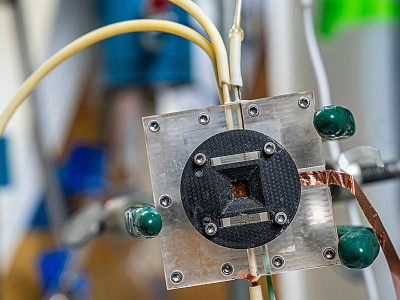
Close-up of an electrochemical device custom-designed for observing CO2 reduction. Credit: Marilyn Sargent/Berkeley Lab
New small-angle X-ray scattering research from the Lawrence Berkeley National Laboratory (Berkeley Lab) and the SLAC National Accelerator Laboratory has revealed the mechanisms which have limited copper catalyst performance. Using the sophisticated x-ray techniques to the catalyst system, the researchers observed how copper nanoparticles change throughout the catalytic process.
Despite its discovery as a potential high-performance catalyst in the 1980s, copper catalysts success has been limited by the degradation of its super-catalytic properties during CO2 electrochemical reduction reactions (CO2RR). Using copper as a catalyst in CO2RR has the potential to transform CO2 into high value fuels and chemicals.
In their research, published in the Journal of the American Chemical Society, the processes which are responsible for copper catalyst performance degradation have been made less mysterious. Thanks to their innovative use of scattering and imaging techniques, researchers discovered that two competing mechanisms drive copper nanoparticles to degrade, particle migration and coalescence (PMC) and Ostwald ripening.
"Our approach allowed us to explore how the nanoscale size distribution evolves as a function of operating conditions, and to identify two different mechanisms that we can then use to guide our efforts to stabilize these systems and protect them from degradation," said Walter Drisdell, a staff scientist in Berkeley Lab's Chemical Sciences Division and principal investigator with the Liquid Sunlight Alliance (LiSA).