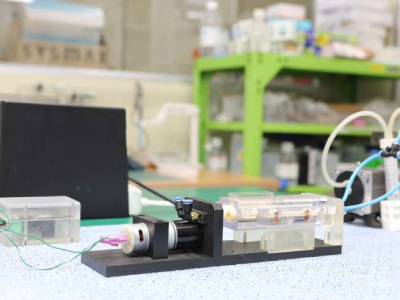
Twin-screw solid sample pretreatment system. Credit: Korea Institute of Machinery and Materials (KIMM)
Researchers from the Korea Institute of Machinery and Materials (KIMM) have developed a novel system which can homogenously liquefy solid biological samples in less than a minute, opening the door to new diagnostic platform while expanding practical implementation of point-of-care (PoC) testing.
The compact device, outlined in the journal Analyst, offers a twin screw mechanism which generates high shear forces for rapid liquefaction and homogenization. To minimize sample loss, the team engineered the screws with integrated internal fluid pathways which lead to a highly optimized collection efficiency.
Using the new device the entire sample prep, retrieval, and cleaning process can be accomplished in under one minute while producing excellent liquid samples that are ready for analysis. Additionally, to broaden access to the device and testing, the team developed a manually operated version which can operate without access to external power sources.
"This twin-screw-based pretreatment technology provides a foundational platform for the practical use of solid-sample diagnostics," concluded Dr. Kwanoh Kim of KIMM. "It offers a technical solution to the limitations of liquid-based IVD systems and is expected to expand the range of diagnostic applications in fields such as agriculture, food safety, and environmental monitoring—enhancing both diagnostic flexibility and analytical accuracy."