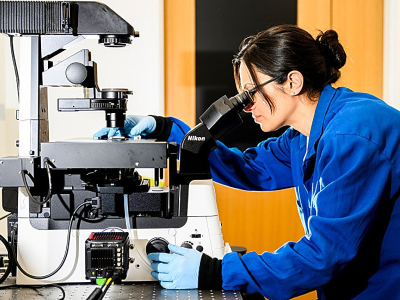
Rouhanifard says the reagent, which she says will better enable biomolecular labeling, was the result of "an accidental finding based on a failed experiment." Credit: Matthew Modoono/Northeastern University
Researchers from Northeastern University have developed a novel technique which harnesses the power of click chemistry to enable safe live cell biomolecular labeling. Given the longstanding challenges faced by chemical biologists when attempting to observe undisturbed cell processes, the technique could provide a new method to track molecular interaction and lead to new discoveries.
Published in the journal Nature, the work included the accidental discovery of a novel copper-chelating ligand the call "InCu-Click". The new agent can bind to copper and mitigate its toxic effect on human cells, enabling sage biomolecular labeling.
As part of the work the researchers have focused on the copper-catalyzed azide-alkyne cycloaddition (CuAAC) reaction, an early yet widely adopted example of click chemistry which provides a way to create new complex molecules from things such as proteins and peptides. Despite its promise, widespread adaptation of the method in live cell research has been low due to toxicity issues.
"Nobody has ever been able to track biomolecules using the CuAAC reaction inside of live cells, and the reason is because copper is toxic to cells," said Sara Rouhanifard, a Northeastern assistant professor specializing in click chemistry and RNA imaging. "You can't just put copper into cells because it will kill them."
However, when paired with the new copper-chelating ligand, the copper in the reaction can be neutralized to a degree that it has proven safe for use in live cells while allowing the reaction to continue. With the high selectivity offered by the method, researchers will be able to better isolate different functional groups without causing harm to non-target groups.
"What we'd really like to achieve with this new reaction is to be able to track single molecules of RNA inside of live cells without having to genetically engineer them," Rouhanifard concluded.
"I want to be able to get a patient sample, for example, and be able to see how the RNA is moving around that cell, and how can I control it so that it doesn't do that in disease. The goal, essentially, is to cure human disease."