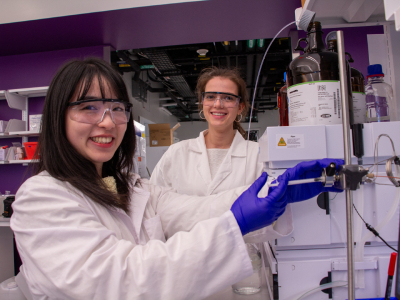
First author Qiuyue Nie and co-author Maria Zotova, from left, purify samples of the fungus. Credit: Bella Ciervo
Researchers have developed a promising cancer-killing compound by isolating a new class of molecules from Aspergillus flavus, a toxic fungus often linked to deaths during ancient tomb excavations.
The therapy is a result of a new class of ribosomally synthesized and post-translationally modified peptides (RiPPs). While thousands of RiPPs have been identified previously, nearly all of those came from bacteria. To date, only a few RiPPs have been identified from fungi, partly because previous researchers misidentified fungal RiPPs as non-ribosomal peptides.
In their research, published in the journal Nature Chemical Biology, the researchers used a novel approach which combined metabolic and genetic information to pinpoint the source of fungal RiPPs in A. flavus, an approach which could also be used to discover more fungal RiPPs in the future. The team named these newly discovered molecules asperigimycins after the fungus they were discovered in.
During their testing the team found that even with no modification, two of the four variants they purified had potent effects against human leukemia cells. Another of the variants, after adding a lipid, performed as well as cytarabine and daunorubicin, two FDA approved drugs which have been used to treat leukemia for decades.
Not only did the researchers demonstrate the treatment potential of asperigimycins, the team also identified similar genes in other fungi which could suggest even more fungal RiPPs remain to be discovered.
"Even though only a few have been found, almost all of them have strong bioactivity," said Qiuyue Nie, a postdoctoral fellow in CBE. "This is an unexplored region with tremendous potential." Next steps for the team include testing the asperigimycins in animal models with the hope of one day moving to human clinical trials.