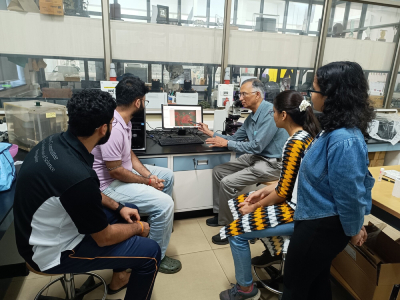
Uday Maitra (third from right) with students in the lab. Credit: UM Group
Using a unique terbium based luminescent probe, Indian Institute of Science (IISc) researchers have developed a novel technique which can detect the presence of β-glucuronidase potentially aiding in the detection of liver cancer.
Published in the journal Chemistry – An Asian Journal, the method relies on decade old findings demonstrating that terbium ions, when used in a gel derived from bile salts, can emit green fluorescence. Using that same gel matrix the team added 2,3-DHN (2,3-Dihydroxynaphthalene) "masked" with glucuronic acid, which after being sliced by β-glucuronidase, releases 2,3-DHN.
"The free 2,3-DHN acts as an 'antenna'—absorbing UV light and transferring the energy to the terbium ions nearby, greatly enhancing their green emission," said Uday Maitra, Honorary Professor in the Department of Organic Chemistry, IISc. "The gel matrix ... ensures sufficient proximity between the 'antenna' and terbium ions, facilitating efficient energy transfer."
Using the new method, the team achieved a LOD of 185 ng/mL, far lower than is needed to detect many liver cancers. Given the wide relevance of β-glucuronidase as a potential biomarker for several types of cancers and toxicties, the method developed could be used to develop a powerful screening tool.
The team intends to carry out more experiments to validate the method, but once done, feel the sensors developed could reduce the detection costs for clinically significant biomarkers.