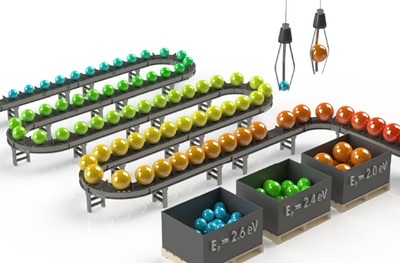
Image credit: Milad Abolhasani.
Researchers have demonstrated a new technique that allows “self-driving laboratories” to collect at least 10 times more data than previous techniques at record speed. The advance expedites materials discovery research, while slashing costs and environmental impact.
Self-driving laboratories are robotic platforms that combine machine learning and automation with chemical and materials sciences to discover materials more quickly. The automated process allows machine-learning algorithms to make use of data from each experiment when predicting which experiment to conduct next to achieve whatever goal was programmed into the system.
Previously, self-driving labs have relied on steady-state flow experiments, which require the lab to wait for the chemical reaction to take place before characterizing the resulting material. That means the system sits idle while the reactions take place, which can take up to 1 hour per experiment.
“We’ve now created a self-driving lab that makes use of dynamic flow experiments, where chemical mixtures are continuously varied through the system and are monitored in real time,” said Milad Abolhasani, corresponding paper author and Professor of Chemical and Biomolecular Engineering at North Carolina State University.“In other words, rather than running separate samples through the system and testing them one at a time after reaching steady-state, we’ve created a system that essentially never stops running. The sample is moving continuously through the system and, because the system never stops characterizing the sample, we can capture data on what is taking place in the sample every half second. This streaming-data approach allows the self-driving lab’s machine-learning brain to make smarter, faster decisions, honing in on optimal materials and processes in a fraction of the time.”
In this work, described in Nature Chemical Engineering, the researchers found the self-driving lab that incorporated a dynamic flow system generated at least 10 times more data than self-driving labs that used steady-state flow experiments over the same period of time. The new system was also able to identify the best material candidates on the very first try after training.