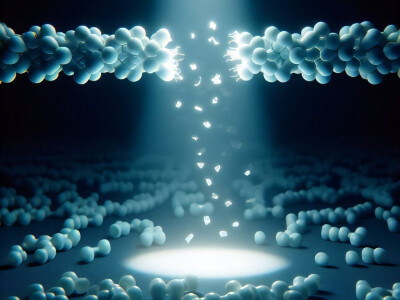
Light exposure cleaves stable chemical bonds in the polymer chain, enabling the recovery of the original building blocks. Credit: Fabian Eisenreich
Researchers at Eindhoven University of Technology (TU/e) have developed a unique technique which uses LED light to both create and break down a new class of advanced plastics. The innovative plastic material fully embraces circular recycling as the process can be conducted repeatedly without any loss in quality.
Published in the Rising Stars edition of Advanced Materials, the work represents a significant breakthrough in the world of sustainable chemistry.
"Plastics typically consist of moldable polymer chains," said Assistant Professor Fabian Eisenreich. "Due to the current way in which plastics are usually recycled—in a nutshell: heating, melting, and reshaping—the quality of those polymer chains deteriorates over time. So you can't keep doing that indefinitely, which means that new plastic will eventually have to be made anyway."
"With the right chemical reaction, a polymer chain can be selectively broken down into its original building blocks. These can then be reused to make exactly the same polymer again, with identical properties and quality," Eisenreich added.
"Making polymers by means of light is relatively simple. But breaking and making them again in the same way, aka recycling, is much more complicated and therefore a whole new line of research," said Eisenreich. The challenge lies in using light to selectively split stable chemical bonds within the polymer, so the original building blocks can be recovered."
Eisenreich and Ahsen Sare Yalin, a third-year Ph.D. candidate in his group, became the first to do just that.
"We see it as a breakthrough in sustainable chemistry that can reshape the way we deal with plastic waste in the future," concluded Eisenreich. "At the moment, our designer polymer is still a niche material and therefore not suitable for everyday plastic applications. Instead, it is aimed at specialized uses, for example, as a recyclable adhesive that binds strongly to glass and other plastics."
Ultimately, further development and optimization could broaden the application possibilities of the technique. Eisenreich sees future potential in closed-loop recycling using light.