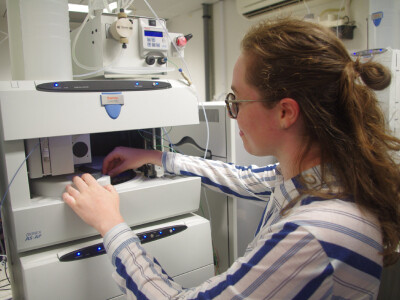
Rachel Williams. Credit Isabelle Legge
Oxford University chemists have published a novel method which provides a more comprehensive analysis of the metabolites found in cells, tissues, and biofluids. The method represents a significant step forward in analysis capabilities for analyzing highly polar and ionic metabolites.
The method, described in the journal Nature Protocols, relies on the use of anion-exchange chromatography coupled with mass spectrometry (AEC-MS) to address the long standing need for accurate, scalable analysis for highly polar and ionic metabolites.
"Ion-exchange chromatography offers a retention and elution mechanism which is new to metabolomics and is proving to be a powerful solution for long-standing analytical challenges in the field," said Rachel Williams, a student in the McCullagh Group at Oxford University.
Metabolomics is one of several omics technologies garnering increased attention for their combinatorial approach to molecular system analysis. The new AEC-MS method has already been used in several research studies which have led to new discoveries in the field.
"Developing a new metabolomics protocol is very exciting. It expands the capability of existing applications, but also enables us to explore and develop new applications," added James McCullagh, Professor in the Department of Chemistry at University of Oxford. "In our lab we are now applying the protocol in several research areas, including investigating gut microbiome metabolism, how antimicrobial resistance impacts bacterial metabolism and in the discovery of biomarkers for the early detection of cancer."