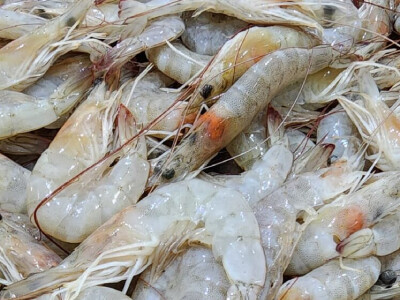
White shrimps before processing. They were collected from Souq Al Jubail in Sharjah, UAE. The shrimps were harvested in Oman. By-products were later used as feedstock for activated carbon. Credit: Haif Al-Jomard / University of Sharjah
University of Sharjah researchers have developed a novel method which uses shrimp waste, which is discarded in large volumes by the seafood industry, into a unique carbon capture product. The method presents a novel waste-to-carbon technology which provides a solution to both waste management and environmental carbon capture.
The method, outlined in the journal Nanoscale, produces activated carbon using the shells, heads, and intestinal tracts of shrimp. The resulting material exhibits excellent CO2 adsorption capabilities, making it a promising candidate for carbon capture projects.
"This approach offers a cost-effective route to producing activated carbon, turning a problematic waste stream into a high-performance, efficient, and environmentally friendly product with wide-ranging applications," said Professor Chaouki Ghenai, co-author and expert in Sustainable and Renewable Energy at the University of Sharjah.
The activated carbon produced by the method could also go beyond carbon capture including use in air or water purification, solvent recovery, and even medical applications. The researchers highlight that the method develops aligns with the principles of circular economy by converting by-products into high value resources.
"Our findings validate a scalable and sustainable strategy for shrimp waste valorization," they added. "The combined thermal, chemical and mechanical treatments of shrimp waste enhance both the textural and chemical properties of the final activated carbon material, making it a viable solution for climate change mitigation."