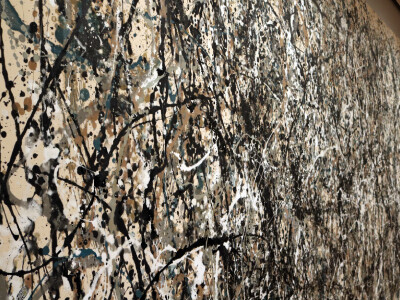
Chemists have solved the longstanding mystery surrounding the origins of the blue color found in one of Jackson Pollock's paintings using resonance Raman spectroscopy. The synthetic pigment, now known to be manganese blue, is one of the last colors to be characterized in the famous work.
The work, published in the journal Proceedings of the National Academy of Sciences, involved analyzing scrapings of the blue paint using Raman spectroscopy to pinpoint its origins. "It's really interesting to understand where some striking color comes from on a molecular level," added study co-author Edward Solomon with Stanford University.
Once popular with artists, manganese blue was phased out by the 1990’s due to environmental concerns. Research has previously suggested that this could in fact be the mysterious pigment, but this newest study confirms those suspicions.
Number 1A, 1948, is currently on display at the Museum of Modern Art in New York.