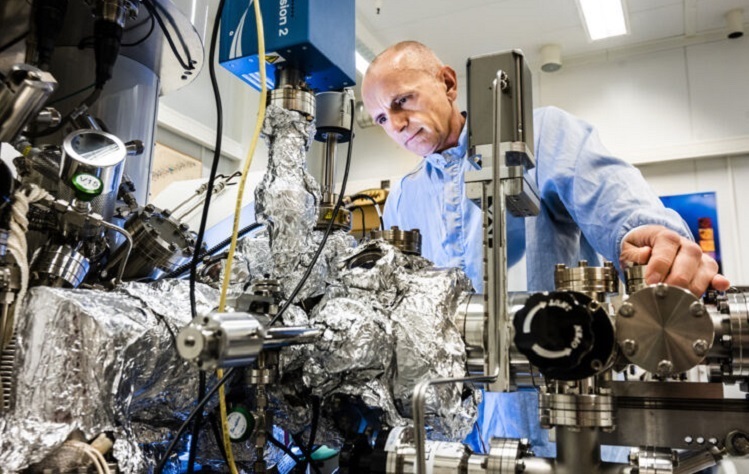
Paper co-author Grzegorz Greczynski in his lab at Linköping University. Credit: Thor Balkhed
Swedish researchers have shown that X-ray photoelectron spectroscopy (XPS)—a standard method in materials science for which its inventor won the Nobel Prize in 1981—is being used erroneously more often than not.
Cited in more than 12,000 journal articles a year, the value of XPS in materials science can hardly be overestimated. And yet, Grzegorz Greczynski and Lars Hultman have shown an erroneous assumption during calibration has led to misleading analysis.
"The pioneering work that led to the Nobel Prize is not in question here,” explains says Lars Hultman, co-author of the paper and a professor at Linköping University. “When the technique was developed initially, the error was comparatively small, due to the low calibration precision of the spectrometers used at the time. However, as spectroscopy developed rapidly and spread to other scientific fields, the instruments have been improved to such a degree that the underlying error has grown into a significant obstacle to future development.”
When using XPS to determine the chemical composition of materials, scientists compare the extracted binding energy values to compound reference databases, such as the NIST XPS. In order to do this, the spectrometer has to be correctly calibrated first. When calibrating the experiment, researchers typically use elemental carbon, as contamination occurs on essentially all samples analyzed by XPS—making the element accessible and simple to use.
Scientists record the C 1s peak of carbon and set the C–C/C–H component at the binding energy values arbitrary chosen from the range 284.6 to 285.2 eV, as recommended by the ISO charge referencing guide. The same rigid binding energy shift is then applied to all sample signals, hence assuming that the correction is independent.
However, in their most recent paper published in Scientific Reports, Greczynski and Hultman demonstrate that the binding energy of the C–C/C–H peak varies depending on not only sample, but also area within the same sample.
In their experiment, for example, the binding energy varied from 286.6 eV for an aluminum foil to 285.0 eV for a gold foil. Additionally, a double C–C/C–H peak was observed at some points.
“This result contradicts the XPS paradigm, in which binding energy of core level peaks is defined by the type and the nature of chemical bonds,” the paper explains.
While there are non-carbon calibration alternatives—such as noble metal decoration, noble gas atom implantation and deposition of organic layers—they are more time- and labor-intensive and, according to the researchers, need further refinement before they can be confidently used. Thus, the authors urge that the ISO and ASTM charge referencing guides be revoked immediately.
“The lack of a reliable energy reference remains a fundamental problem in XPS analyses of insulating materials with far-reaching consequences for many fields of modern materials science,” the scientists write.
As they point out, this isn’t the first time XPS has come under criticism. In the 1970s and early 1980s, scientists were calling attention to the possible calibration error; but, it still managed to go unaddressed for nearly 40 years.
Hultman believes this is due to digital publishing and the subsequent increase in the number of journals, as well as deficient reviewing procedures.
"Not only has a rapidly growing number of scientists failed to be critical, it seems that there is a form of carelessness among editors and reviewers for the scientific journals,” he said. “This has led to the publishing of interpretations of data that are clearly in conflict with basic physics. You could call it a perfect storm. It's likely that the same type of problem with deficient critical assessment of methods is present in several scientific disciplines. In the long-term, this risks damaging research credibility," Hultman concludes.