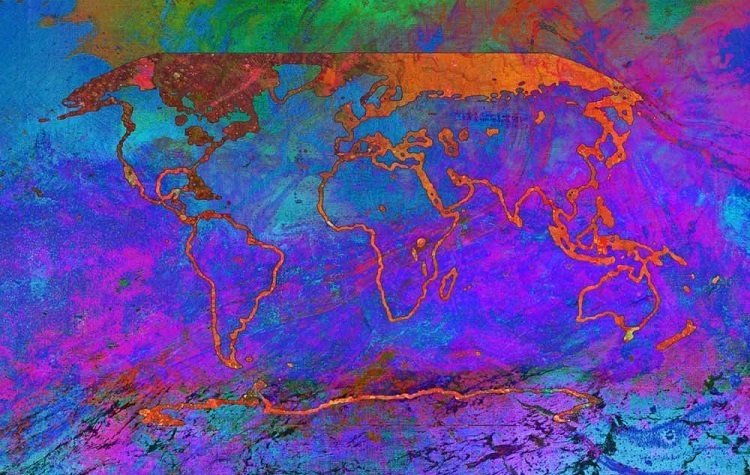
Changing by the artist Alisa Singer. Credit: Alisa Singer/IPCC
If you’ve ever tried to get your family to agree on a restaurant for a night out, you know how difficult it is to get everyone on the same page.
That makes the publication of the Intergovernmental Panel on Climate Change’s (IPCC) report on Monday all the more impressive when you consider the fact that all 234 scientists and 195 governments had to agree on the report’s summary.
“The IPCC uses a transparent process to produce its report—the authors have had to respond to over 50,000 review comments over the three years we’ve spent writing it,” explained Robert Kopp, a lead author of the chapter on Earth’s oceans, ice and sea level rise. “The governments also weigh in, having to approve every line of a concise Summary for Policy Makers that accurately reflects the underlying assessment – oftentimes making it clearer in the process.”
Overall, the Sixth Assessment Report indicates a faster warming Earth with every region facing changes beyond temperature, including some that are considered irreversible at this point.
“Many of the changes observed in the climate are unprecedented in thousands, if not hundreds of thousands of years, and some of the changes already set in motion—such as continued sea level rise—are irreversible over hundreds to thousands of years,” reads the report.
More knowledge
While the IPCC has published previous reports—the last one in 2013—the Sixth Assessment Report provides a more detailed regional assessment of climate change, including a focus on information that can inform risk assessment, adaptation and other decision-making.
Part of this upgrade comes from the advancing innovations and understanding across a spectrum of scientists and researchers dedicated to the topic of climate change.
“This assessment is based on improved observational datasets to assess historical warming, as well progress in scientific understanding of the response of the climate system to human-caused greenhouse gas emissions,” said IPCC Working Group I Co-Chair Valérie Masson-Delmotte. “[It] is a reality check. We now have a much clearer picture of the past, present and future climate, which is essential for understanding where we are headed, what can be done and how we can prepare.”
Hot, hot, hot
According to the report, emissions of greenhouse gases from human activities are responsible for approximately 1.1°C of warming since 1850-1900. And now, unless there are “immediate, rapid and large-scale reductions in greenhouse gas emissions,” global warming of 1.5°C and 2°C will be exceeded during the 21st century.
Increasing heat waves, longer warm seasons and shorter cold seasons will characterize a 1.5°C warmer Earth. At 2°C of global warming, heat extremes will more often reach critical tolerance thresholds for agriculture and health.
Beyond temperature, global warming is wreaking the most havoc on the global water cycle. Thus far, climate change has brought more intense rainfall and associated flooding, as well as more intense drought in many regions.
According to the report, precipitation in high latitudes is likely to increase, while it is projected to decrease over large parts of the subtropics. Changes to monsoon precipitation are also expected. Coastal areas will see continued sea level rise throughout the 21st century, contributing to more frequent and severe coastal flooding in low-lying areas and coastal erosion.
“Extreme sea level events that previously occurred once in 100 years could happen every year by the end of this century,” reads the report summary.
Irreversible changes
While the report encourages humans to do what they can to limit future climate change, some alterations due to past and future greenhouse gas emissions are already irreversible for centuries to millennia, especially changes in the ocean, ice sheets and global sea level.
For example, according to Kopp’s article in The Conversation, sea level change is locked in through 2050. Beyond 2050, however, sea level will be increasingly sensitive to the world’s emissions.
The Rutgers professor of atmospheric science modeled the following scenario: if countries continue on their current paths, with greenhouse gas emissions likely to bring 3-4°C of warming by 2100, the planet will be looking at a most likely sea level rise of about 0.7 meters. A 2°C warmer world—consistent with the Paris Agreement—would see lower sea level rise, most likely about half a meter by 2100.
“What’s more, the more the world limits its greenhouse gas emissions, the lower the chance of triggering instabilities in the polar ice sheets that are challenging to model but could substantially increase sea level rise,” the Rutgers professor of atmospheric science explains in his article. “Under the most extreme emissions scenario we considered, we could not rule out rapid ice sheet loss leading to sea level rise approaching 2 meters by the end of this century.”
Indeed, the report includes mentions of what it calls “low-likelihood outcomes” that cannot be ruled out and are part of the larger risk assessment. These include the complete collapse of the ice sheet, abrupt ocean circulation changes, compound extreme events and warming substantially larger than the assessed “very likely” range.
For example, Kopp says, there are certain processes with respect to ice sheet changes on which there is broad agreement and other processes where the science is still emerging and there are strong, discordant views.
“Yet, knowing about these processes may be crucially important for decision-makers trying to manage risk,” writes Kopp. “That’s why we talk not only about most likely outcomes, but also about outcomes where the likelihood is low or as-yet unknown, but the potential impacts are large.”