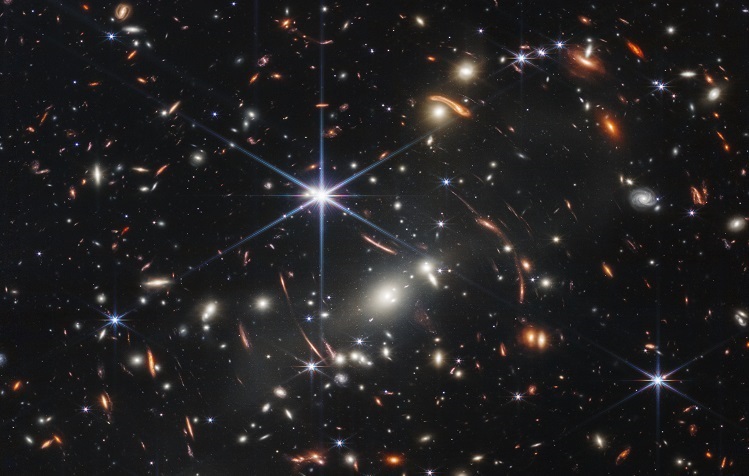
Webb’s First Deep Field is galaxy cluster SMACS 0723, and it is teeming with thousands of galaxies, including the faintest objects ever observed in the infrared. Credit: NASA, ESA, CSA, and STScI
In an extremely glitchy press conference Tuesday morning, NASA revealed the first five images taken by the James Webb Space Telescope. The magnitude of the moment was not lost on the Webb telescope team who, as the images were revealed, seemed truly at a loss for words.
The presentation of the images is a reflection of two very long journeys: the 25-year, $10-billion road to launching the most powerful telescope ever, and the much-longer journey of the 13-billion-year-old oxygen detected in galaxy cluster SMACS 0723 that would eventually give life to humans.
“This is how the oxygen in our bodies was made—in stars. And you’re seeing that process get started,” said Jane Rigby, operations project scientist for the Webb telescope, as she unveiled the deepest infrared image of a distant galaxy thus far.
The image shows the galaxy cluster SMACS 0723 as it appeared 4.6 billion years ago, with many more galaxies in front of and behind the cluster. If you zoom in on the image, you can even see faint red galaxies where new clusters are forming, “like popcorn,” Rigby explained.
Webb’s Near Infrared Spectrograph (NIRSpec) microshutter array revealed light more than 13.1 billion years old—less than a billion years after the Big Bang. As the NIRSpec continues to obtain spectra, the data will reveal how exactly how detailed galaxy spectra is going to be with Webb.
If you think the galaxies in the photo look stretched, you are correct. The powerful gravitational field of a galaxy cluster can bend the light rays from more distant galaxies behind it, like a magnifying glass bends and warps images. Thus, the pictured galaxies look stretched and pulled.
“Just as Einstein said they would,” remarked Rigby.
The deep field is a composite made from images at different wavelengths, totaling 12.5 hours. With Webb’s predecessor, the still-active Hubble Space Telescope, such an image would have taken weeks.
Carina Nebula
In a photo of the edge of a young, star-forming region called NGC 3324 in the Carina Nebula, Webb reveals emerging stellar nurseries and individual stars previously invisible. Because of Webb’s sensitivity to infrared light, it can peer through cosmic dust to see objects like protostellar jets—which are clearly in this image—that shoot out from some of the young stars. The youngest stars appear as red dots in the dark, dusty region of the cloud.
This landscape of “mountains” and “valleys” speckled with glittering stars is actually the edge of a nearby, young, star-forming region called NGC 3324 in the Carina Nebula. Credit: NASA, ESA, CSA, and STScI
These observations of NGC 3324 will shed light on the process of star formation. As seen in the photo, the gigantic, hot, young stars at the top of the rim are pushing radiation and stellar winds into the nebula, and running into the gas and dust at the bottom of the image.
“While gas and dust are great raw materials for newborn stars and baby planets, there’s a flipside in that the same processes can also erode away the material and actually stop star formation,” explained Amber Straughn, deputy project scientist for Webb.
NASA says this line of research from Webb will address open questions of modern astrophysics including: What determines the number of stars that form in a certain region? And why do stars form with a certain mass?
While the effect of massive stars is often apparent, less is known about the influence of the more numerous low-mass stars. As they form, these smaller stars create narrow, opposing jets—visible in the image—that can inject momentum and energy into gas and dust clouds. This reduces the fraction of nebular material that seeds new stars. Up to this point, scientists have had very little data about the influence of the multitude of young and more energetic low-mass stars. With Webb, they will be able to obtain a full census of their number and impact throughout the nebula.
“When I see this, I can’t help but think about scale,” said Straughn. “Every dot of light we see here is an individual star not unlike our sun, and many of these also likely have planets. It reminds me that our sun, and our planets, and ultimately us were formed out of the same kind of stuff we see here. We humans really are connected to the universe. We’re made of the same stuff we see in this landscape.”
Southern Ring Nebula
Of course, Webb doesn’t only capture stars in their infancy. It can also image star death, as two cameras aboard Webb did with planetary nebula NGC 3132, known informally as the Southern Ring Nebula.
Two cameras aboard Webb captured the latest image of this planetary nebula, cataloged as NGC 3132, and known informally as the Southern Ring Nebula. Credit: NASA, ESA, CSA, and STScI
While astronomers knew it was a binary star, they had not previously been able to image the second star, which Webb’s Mid-Infrared Instrument (MIRI) shows is surrounded by dust.
As the pair continues to orbit one another, they “stir the pot” of gas and dust, causing asymmetrical patterns. Each shell represents an episode where the fainter star lost some of its mass. As the star ejects shells of material, dust and molecules form within them. This dust will eventually enrich the areas around it, expanding into what’s known as the interstellar medium. And since it’s very long-lived, the dust may end up traveling through space for billions of years and become incorporated into a new star or planet.
Observations taken with NIRCam also reveal extremely fine rays of light around the planetary nebula.
“The rays are holes in the inner nebular that allow the central stars light to come out, like patchy clouds with the sun shining through,” said Karl Gordon, Webb instrument scientist.
Stephan’s Quintet
In Webb’s largest image to date, the telescope captured new details about Stephan’s Quintet, a visual grouping of five galaxies NASA describes as a “fantastic laboratory” for studying galaxy-related processes.
With its powerful, infrared vision and extremely high spatial resolution, Webb shows never-before-seen details in this galaxy group known as Stephan's Quintet. Credit: NASA, ESA, CSA, and STScI
Four of the galaxies, which are about 300 million light years away, are locked in a cosmic dance. Two of those, seen toward the center of the image, are in the process of merging.
“This is a very important image to study because it shows the type of interaction that drives the evolution of galaxies,” said Giovanna Giardino, Webb NIRSpec scientist. Rarely do scientists see in so much detail how interacting galaxies trigger star formation in each other, and how the gas in these galaxies is being disturbed.
The fifth and leftmost galaxy, NGC 7320, is well in the foreground compared with the other four as it is only 40 million light years from Earth. In cosmic terms, this is fairly “close,” and studying nearby galaxies like these can help scientists better understand structures seen in a more distant universe.
Webb’s NIRSpec studied the active galactic nucleus, shedding light on the composition and temperature of gas around an active black hole. This will help scientists understand the rate at which supermassive black holes feed and grow.
“This [image] is just the beginning,” said Giardino. “[These] photos were taken over just 5 days, and we’re taking new ones every 5 days. It’s decades of work.”
WASP-96 b
Webb has captured the distinct signature of water in the atmosphere surrounding exoplanet WASP-96 b, a hot, puffy gas giant planet that orbits extremely close to its Sun-like star every 3.5 days.
The image reveal shows the first spectrum of the exoplanet. On June 21, Webb’s Near-Infrared Imager and Slitless Spectrograph (NIRISS) measured light from the WASP-96 system for 6.4 hours as the planet moved across the star. The result is a light curve showing the overall dimming of starlight during the transit, and a transmission spectrum revealing the brightness change of individual wavelengths of infrared light between 0.6 and 2.8 microns.
While the light curve confirms properties of the planet that had already been determined from other observations—such as existence, size and orbit—the transmission spectrum reveals previously hidden details of the atmosphere: the unambiguous signature of water, indications of haze, and evidence of clouds that were thought not to exist.
WASP-96 b is one of more than 5,000 confirmed exoplanets in the Milky Way. Located roughly 1,150 light-years away in the southern-sky constellation Phoenix, it represents a type of gas giant that has no direct analog in our solar system. Credit: NASA, ESA, CSA, and STScI
“It’s exciting because it covers infrared wavelengths of light we have not had access to before,” said Knicole Colone, Webb deputy project scientist for exoplanet science. “We’ve been able to use other telescopes to explore exoplanet atmosphere in the infrared, but not to this level of detail.”
Researchers will be able to use the spectrum to measure the amount of water vapor in the atmosphere, constrain the abundance of various elements like carbon and oxygen, and estimate the temperature of the atmosphere with depth. They will also use the data to make inferences about the overall make-up of the planet, as well as how, when and where it formed.
While exploration of exoplanets was not originally a goal for Webb, that has since changed. Over the coming year, researchers will use spectroscopy to analyze the surfaces and atmospheres of several dozen exoplanets, from small rocky planets to gas- and ice-rich giants. In fact, nearly one-quarter of Webb’s Cycle 1 observation time is allocated to studying exoplanets and the materials that form them.
“We will be going to smaller planets next, using NIR and three other scientific instruments,” said Colone. “We’re going to look at more Earth-like planets, and even planets in our own solar system.”
Seeing is believing
The common thread of each image reveal was time. The amount of data astronomers can now generate with the Webb telescope in days—even hours—is unprecedented. The scientists were truly giddy as they revealed the images and data, but were perhaps even more excited by what is to come.
“Everything you see [in the first five photos] was done in a week,” said Rigby. “And we’re going to keep doing it.”