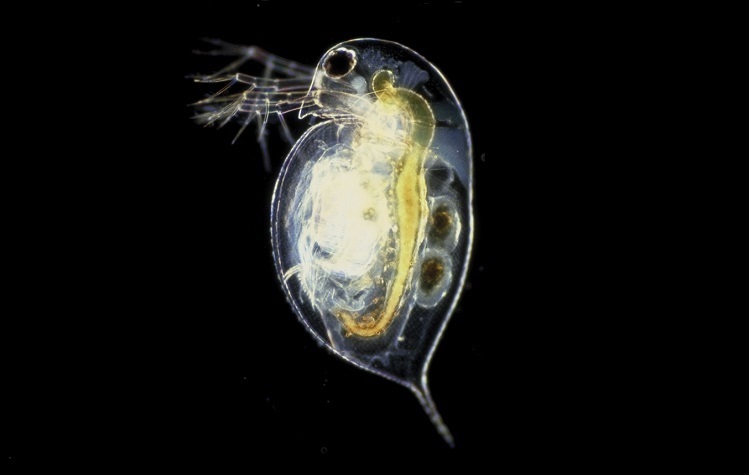
The species Daphnia pulex. Credit: Paul Hebert via Functional Genomics Thickens the Biological Plot. Gewin V, PLoS Biology Vol. 3/6/2005, e219. doi:10.1371/journal.pbio.0030219
No doubt you’ve heard of canaries in a coal mine, but have you ever considered fleas in a river? Researchers at the University of Birmingham (UK) have, and they are advocating for their use not only as an “early warning system” for chemical pollution in lakes and rivers, but also as a bioremediation agent where pollution prevention has failed.
Water fleas, or Daphnia, have long been recognized as a “sentinel species”—used to identify and set exposure limits on toxic chemicals—but a new omics-based framework from Muhammad Abdullahi and colleagues significantly expands and refines the role of these tiny planktonic crustaceans, who measure about the size of a grain of rice.
The framework uses a three-tiered approach. First, nontargeted analysis is used to characterize the chemicals present in water samples taken from rivers and lakes. High-throughput omics technologies, including transcriptomics and metabolomics, are then used to identify the biomolecular responses activated in Daphnia by these chemicals.
Those responses are measured through transcriptional coordination among genes/metabolites in co-response modules. The genes within the co-response modules are annotated using gene ontologies, which enables the machine learning-based framework to use orthologs to identify cross-species extrapolation—shedding light on specific chemical pollutants and their potential effects on species present in the area.
But, pollutant detection is not the only skill Daphnia possesses. In the first proof-of-concept study of its kind, the University of Birmingham researchers show Daphnia can work as a bioremediation agent in areas that are extremely over-polluted and/or where pollution prevention techniques have previously failed.
After first confirming that Daphnia survives in wastewater and eliminates chemicals better or equally as well as other agents, Abdullahia and team then tested the removal efficiency of different Daphnia strains to see if any had higher decontamination abilities.
The researchers tested two Daphnia strains naïve to chemical stress and two that had experienced historical chemical stress. All strains were exposed to 48 hours of arsenic, atrazine and PFOS.
According to the study published in Environmental Science and Technology, on average, Daphnia removed 60% of arsenic, 60% of atrazine and 47% of PFOS. However, the strains had different removal efficiencies across the three chemicals. Both strains historically exposed to chemical stress showed higher removal efficiency to atrazine and arsenic (65% and 71%, respectively). Meanwhile, one naïve strain showed the highest removal efficiency to PFOS at 59%.
“We need better diagnosis of the impact of chemicals on wildlife and humans but also, when chemicals have entered the environment we need a sustainable remediation of their impact,” said senior author Luisa Orsini, professor of evolutionary systems biology and environmental omics. “Daphnia is a tiny crustacean the size of a grain of rice and are often-overlooked; yet, they are super abundant and can revolutionize the way we assess and mitigate chemical pollution sustainably.”
Additionally, the framework can be—in principle—extended to other model species, according to the study.
The researchers say their study shows that nature-based solutions are a promising alternative to current chemical/mechanical processes to enable water reuse. The new approach also provides the opportunity to reduce chemical testing in animals.