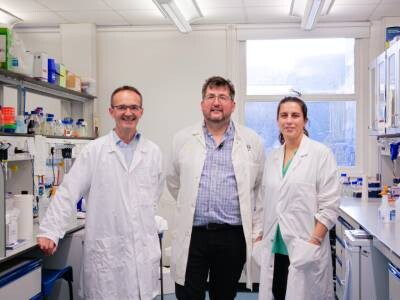
Warwick research team responsible for the discovery of pre-methylenomycin C lactone. Credit: University of Warwick
Chemists have discovered a promising antibiotic which shows activity against drug resistant bacteria, including MRSA and VRE. With Antimicrobial resistance (AMR) being one of the worlds most urgent health challenges and a recent WHO report showing "too few antibacterials in the pipeline," the findings of the study could not be timelier.
In a recent publication in the Journal of the American Chemical Society, chemists from the Monash Warwick Alliance Combating Emerging Superbug Threats Initiative describe pre-methylenomycin C lactone, a promising new antibiotic the team describes as "hiding in plain sight".
"Methylenomycin A was originally discovered 50 years ago and while it has been synthesized several times, no-one appears to have tested the synthetic intermediates for antimicrobial activity," said Greg Challis, Professor in the Department of Chemistry at the University of Warwick, and Biomedicine Discovery Institute at Monash University
"By deleting biosynthetic genes, we discovered two previously unknown biosynthetic intermediates, both of which are much more potent antibiotics than methylenomycin A itself."
When tested for antimicrobial activity pre-methylenomycin C lactone was shown to be mover than 100 times more active against diverse Gram-positive bacteria than the original methylenomycin A. Of particular interest, pre-methylenomycin C lactone was shown to be effective against S. aureus and E. faecium, the bacterial species responsible for MRSA and VRE.
"Remarkably, the bacterium that makes methylenomycin A and pre-methylenomycin C lactone—Streptomyces coelicolor—is a model antibiotic-producing species that's been studied extensively since the 1950s. Finding a new antibiotic in such a familiar organism was a real surprise," added Dr. Lona Alkhalaf, Assistant Professor, University of Warwick.
"It looks like S. coelicolor originally evolved to produce a powerful antibiotic (pre-methylenomycin C lactone), but over time has changed it into methylenomycin A—a much weaker antibiotic that may play a different role in the bacterium's biology."
"This discovery suggests a new paradigm for antibiotic discovery," concluded Professor Challis. By identifying and testing intermediates in the pathways to diverse natural compounds, we may find potent new antibiotics with more resilience to resistance that will aid us in the fight against AMR"