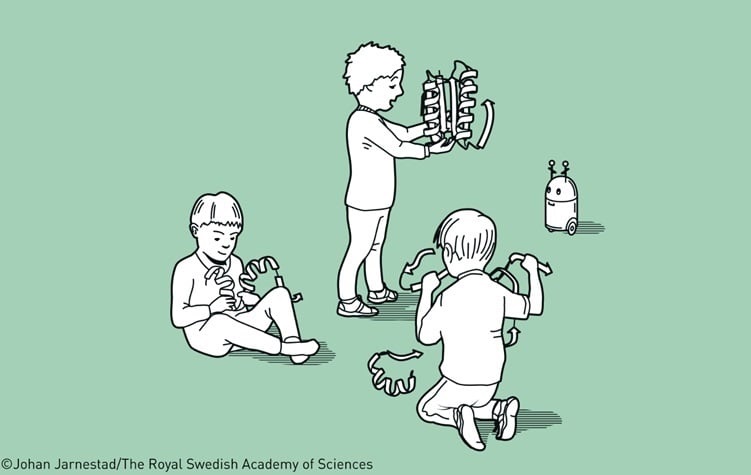
A protein can consist of everything from tens of amino acids to several thousand. Credit: ©Johan Jarnestad/The Royal Swedish Academy of Sciences
The Noble Prize in Chemistry 2024 has been awarded to David Baker (University of Washington) for computational protein design, and Demis Hassabis and John M. Jumper (Google DeepMind) for protein structure prediction.
Baker developed computerized methods for achieving what many people believed was impossible: creating proteins that did not previously exist and which, in many cases, have entirely new functions.
Demis Hassabis and John Jumper utilized artificial intelligence to successfully solve a problem that chemists wrestled with for over 50 years: predicting the three-dimensional structure of a protein from a sequence of amino acids. This has allowed them to predict the structure of almost all 200 million known proteins.
Baker received half of the prize, while Hassabis and Jumper jointly received the other half.
“It is hardly possible to overstate the potential encompassed by life’s chemical building blocks, these 20 amino acids. The Nobel Prize in Chemistry 2024 is about understanding and mastering them at an entirely new level,” the Nobel Committee for Chemistry said in a press release.
David Baker
Initially interested in philosophy and social science, Baker changed his line of study—and his entire life—after he read the now classic textbook Molecular Biology of the Cell. Baker fell hard and deep into cell biology and protein structures.
In 1993, Baker started as group leader at the University of Washington. By 1998, he had developed Rosetta, computer software that could predict protein structures. The success of Rosetta led him to a seemingly crazy idea: could the software be used in reverse? In other words, instead of entering amino acid sequences in Rosetta and getting protein structures out, could researchers enter a desired protein structure and obtain suggestions for its amino acid sequence?
To test the theory and their software, Baker and team drew a protein with an entirely new structure, and then had Rosetta compute which type of amino acid sequence could result in the desired protein. Rosetta searched a database of all known protein structures, and looked for short fragments of proteins that had similarities with the desired structure. The software then optimized these fragments and proposed an amino acid sequence.
Rosetta succeeded with flying colors. The protein that Rosetta spit out and the team developed—called Top7—had almost exactly the structure they had originally designed.
Baker published his discovery of Top7 in 2003. From then, one incredible protein creation after the other has emerged from Baker’s laboratory. Additionally, Baker released the code for Rosetta, enabling the global research community to continue to develop the software.
Demis Hassabis
Hassabis was born to be a computer scientist. He started playing chess at the age of four and achieved master level as a 13-year-old. In his teens, he started a career as a programmer and successful games developer. In 2010, he co-founded DeepMind, a company that developed masterful AI models for popular board games. It was sold to Google in 2014.
But board games were not the end all for Hassabis—he has his sights set higher. In 2018, Hassabis and team showed off their AI model AlphaFold, which could predict protein structures. At the time, the industry standard was a protein prediction accuracy of 40 percent, at best. AlphaFold reached almost 60 percent, a huge feat. But it still wasn’t good enough. For success, the prediction had to have an accuracy of 90 percent when compared to the target structure.
Development on AlphaFold continued but Hassabis reached a sort of dead end—until a relatively new employee shared his ideas on how to improve the AI model.
John Jumper
Jumper joined DeepMind in 2017 after receiving his doctorate that year from the University of Chicago. He initially studied physics and math but changed routes a little after he worked at a company that used supercomputers to simulate proteins and their dynamics in 2008. Jumper took this newly acquired interest in proteins with him when, in 2011, he began his doctorate in theoretical physics.
With the team struggling to improve AlphaFold, Hassabis promoted Jumper to take advantage of his creative ideas. Together, Hassabis and Jumper created a new version—AlphaFold 2—based on Jumper’s known of proteins and a recent breakthrough in AI: neural networks called transformers. Transformers can find patterns in enormous amounts of data in a more flexible manner than previously, and efficiently determine what should be focused on to achieve a particular goal.
The team trained AlphaFold2 on the vast information in the databases of all known protein structures and amino acid sequences. The new AI architecture started delivering excellent results.
In 2020, biochemistry’s 50-year-old challenge was deemed over. When tested, in most cases, AlphaFold2 performed almost as well as X-ray crystallography.
Based on the stunning results, Hassabis and Jumper went on to calculate the structure of all human proteins. Then they predicted the structure of virtually all the 200 million proteins that researchers have so far discovered when mapping Earth’s organisms.
Like Baker, Google DeepMind made the code for AlphaFold2 publicly available. By October 2024, AlphaFold2 had been used by more than 2 million people from 190 countries. Previously, it took years to obtain a protein structure, if at all. Now, it can be done in a few minutes.
Background information provided by The Royal Swedish Academy of Sciences