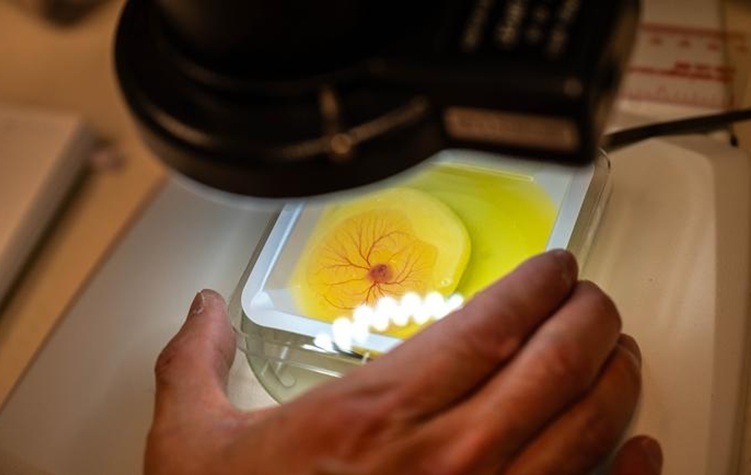
Researchers at UBC’s faculty of medicine are using chicken eggs to study how childhood cancers respond to different treatments. Credit: Paul Joseph/UBC
A pan-Canadian team tapped into the power of proteomics to expediently identify and test a drug to target a young patient's tumor in time for necessary treatment.
The work was a collaborative effort of PROFYLE (PRecision Oncology For Young peopLE), a key initiative of the Canadian pediatric cancer network ACCESS that brings together more than 30 research and funding organizations and over 100 investigators from across Canada to improve cancer outcomes for children and young adults.
The study, led by researchers from the University of British Columbia and BC Children’s Hospital Research Institute (BCCHR), focused on an unnamed patient diagnosed with a rare pediatric cancer that resisted conventional treatments, including standard chemotherapy.
The doctors then chose a drug selected by genomics, but the tumor quickly became resistant. The team conducted further genetic testing; but, no clear drug candidates emerged from this testing, either. Since most drugs work by changing the activity of proteins, the team wondered if proteomics could provide a better answer.
They turned to proteomics and discovered that the tumor’s metabolism relied heavily on an enzyme known as SHMT2. Based on this information, the team devised a strategy to use sertraline—a common antidepressant—to inhibit SHMT2 and cut off the tumor’s access to a key energy source.
“With genomics alone, we couldn’t find a clear treatment option,” said Philipp Lange, study author and senior investigator with the Michael Cuccione Childhood Cancer Research Program at BCCHR. “But by looking at the tumor’s proteins, we found a critical metabolic weakness that we could target with an already approved drug.”
To test their strategy, researchers grew a small piece of the patient’s tumor on a chicken egg, serving as an avatar host for the tumor. Growing an identical tumor outside the patient gave the doctors a way to test for personalized drug responses in a matter of weeks.
“This technique speeds up the process of evaluating a treatment option in a way that simply wouldn’t be possible with traditional methods,” said study author and senior investigator James Lim. “We could quickly confirm whether the drug we identified through proteomics could actually work for the patient’s tumor.”
When the team presented the results to a panel of experts established by PROFYLE, they agreed that sertraline was the best available treatment option for the patient.
After beginning sertraline treatment, the patient’s tumor growth slowed—but did not stop. Although promising, the sertraline was not a cure, as additional treatment was still needed.
The team is the first in Canada to leverage proteomics and chicken eggs in real-time cancer therapies.
“While there is more work to be done, this study shows that our approach can deliver personalized treatment recommendations fast enough to actually help patients with rare and difficult-to-treat cancers,” said Lange. “We now hope to expand this method to other children to identify effective treatments faster across the country.”