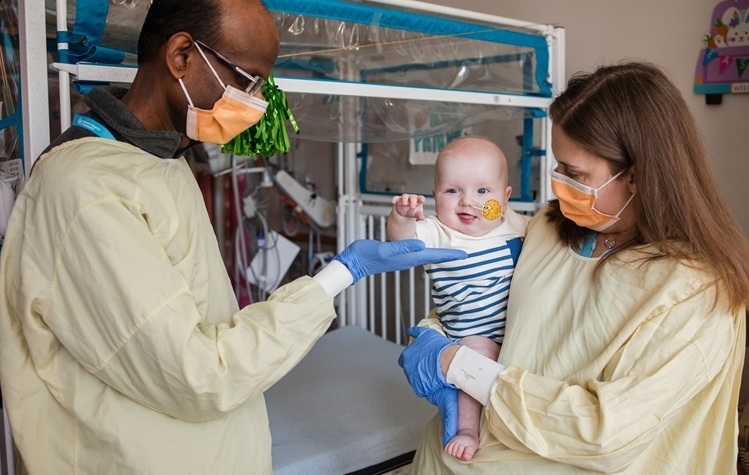
Kiran Musunru, MD, PhD, MPH, ML, MRA, (left) and Rebecca Ahrens-Nicklas, MD, PhD, (right) led the group of researchers from CHOP and Penn who developed a personalized treatment for Baby KJ.
A 6-month-old born with a rare genetic disorder is the world’s first person successfully treated with a customized CRISPR gene editing therapy in a historic medical breakthrough.
The infant, KJ, was diagnosed with a rare metabolic disease—an urea cycle disorder known as severe carbamoyl phosphate synthetase 1 (CPS1) deficiency. During the normal breakdown of proteins in the body, ammonia is naturally produced. Typically, our bodies know to convert the ammonia to urea and then excrete that urea through urination. However, a child with a urea cycle disorder lacks an enzyme in the liver needed to convert that ammonia to urea. Ammonia then builds up to a toxic level, which can cause organ damage, particularly in the brain and the liver.
Typically, patients with CPS1 deficiency are treated with a liver transplant. However, KJ was not medically stable nor old enough to handle such a procedure. This led researchers to seek an alternative option.
Rebecca Ahrens-Nicklas, MD, PhD, director of the Gene Therapy for Inherited Metabolic Disorders Frontier Program at Children’s Hospital of Philadelphia (CHOP), and Kiran Musunuru, MD, PhD, Professor of Translational Research at the University of Penn, began collaborating to study the feasibility of creating customized gene editing therapies for individual patients in 2023, building upon many years of research into rare metabolic disorders. Luckily, they had decided to focus on urea cycle disorders.
When KJ was born and diagnosed with a rare urea cycle disorder—after the doctor duo completed years of preclinical research with similar disease-causing variants—Ahrens-Nicklas and Musunuru stepped up right away.
Targeting KJ’s specific variant of CPS1, their team designed and manufactured a base editing therapy delivered via lipid nanoparticles to the liver in to correct the infant’s faulty enzyme in just 6 months.
In late February 2025, between 6 and 7 months old, KJ received his first infusion of the experimental therapy, with follow-up doses in March and April. According to the case study, newly published in the New England Journal of Medicine, KJ has had no serious side effects to date.
In fact, in the time since treatment, researchers report that KJ has tolerated increased dietary protein and needed less nitrogen scavenger medication. He also has been able to recover from certain typical childhood illnesses, like rhinovirus, without ammonia building up in his body.
The team notes that longer follow-up is needed to fully evaluate the benefits of the therapy. Still, the findings could provide a pathway for gene editing technology to be successfully adapted to treat individuals with rare diseases.
“Years and years of progress in gene editing and collaboration between researchers and clinicians made this moment possible, and while KJ is just one patient, we hope he is the first of many to benefit from a methodology that can be scaled to fit an individual patient’s needs,” said Ahrens-Nicklas.
The doctor’s co-author agrees.
“We want each and every patient to have the potential to experience the same results we saw in this first patient, and we hope that other academic investigators will replicate this method for many rare diseases and give many patients a fair shot at living a healthy life,” said Musunuru. “The promise of gene therapy that we’ve heard about for decades is coming to fruition, and it’s going to utterly transform the way we approach medicine.”