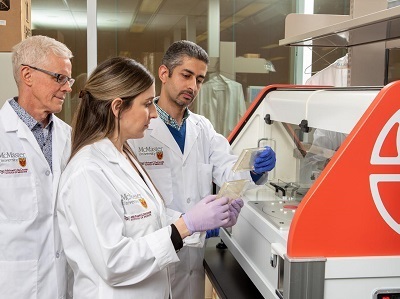
Eric Brown (left), Maya Farha (center) and Omar El-Halfawy are authors of the study and members of the Michael G. DeGroote Institute for Infectious Disease Research and Department of Biochemistry and Biomedical Sciences at McMaster University. Credit: McMaster
In a new study, researchers from McMaster University took two steps toward exploiting cannabis for its antibiotic properties. First, they showed the cannabinoid CBG displays antibacterial activity against drug-resistant MRSA in mice. Then, they solved a long elusive mystery—the mode of action of cannabinoids against bacteria, both Gram-positive and Gram-negative superbugs.
The research team investigated 18 commercially available cannabinoids that all showed antibacterial activity, some more than others. Cannabigerol, or CBG, showed potent antibacterial activity in assays. Unlike THC, it is non-psychoactive and non-sedative, making it the perfect target.
In the lab, when testing the antibacterial activity of CBG against drug-resistant MRSA, the researchers discovered that it prevented the ability of S. aureus to form biofilms. Additionally, it destroyed pre-formed biofilms and dormant “persistor” MRSA cells that are highly resistant to antibiotics.
“We showed the efficacy of CBG to treat infections in animals, where it cured mice of MRSA infections, while not showing signs of toxic side-effects on the animals,” said postdoctoral fellow Omar El-Halfawy, co-author of the study recently published in American Chemical Society Infectious Diseases.
CBG killed drug-resistant S. aureus by targeting the cell membrane of the bacteria. However, it’s not that simple when trying to kill Gram-negative superbugs like Acinetobacter baumannii and Pseudomonas aeruginosa.
“Despite early reports describing certain aspects of the antibacterial activity of cannabis, the way these molecules exert their activity has been unclear. This was not a trivial task, but we employed different strategies and methodologies to that end until we identified [the target],” El-Halfawy told Laboratory Equipment.
As it turns out, that target is an additional outer membrane that Gram-negative bacteria possess, but Gram-positive do not.
“This outer membrane doesn’t allow most antibiotics into the bacterial cell,” explained Halfawy. “By itself, CBG is not effective against Gram-negative bacteria; however, we found that if we gave CBG with another drug that permeabilizes this outer membrane, CBG could penetrate and kill Gram-negative bacteria.”
Now that the researchers have shown CBG is a good lead compound from which novel molecules can be designed and synthesized, further testing to improve the drug’s potency and enhance tolerability is the immediate next step. Long-term, it is their hope that a derivative or a molecule inspired by CBG could be developed as an antibiotic to join the fight against superbugs. As it stands now, scientists have not discovered a new class of antibiotics in more than 30 years—even as antibiotic-resistance worsens throughout the world. Thus, a cannabis-derived antibiotic would be novel for multiple reasons.