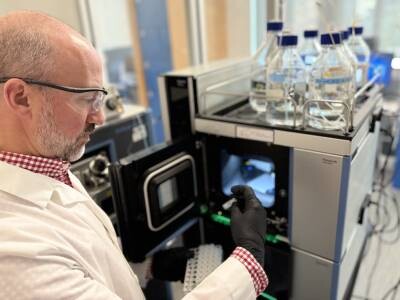
Lee Ferguson loads a water sample into one of his laboratory's powerful mass spectrometers, which are used to discover chemicals and contaminants in environmental samples. Credit: Duke University
Environmental chemists from Duke University have solved the longstanding mystery surrounding the source of the high PFAS levels contaminating water sources in a North Carolina region. The contamination was traced back to a local textile manufacturing plant by analyzing sewage samples around Burlington, North Carolina.
For years the source of the contamination remained hidden because the facility was not releasing forms of PFAS which are regulated and monitored, instead it was releasing solid nanoparticle PFAS precursors which degrade into PFAS that current tests are designed to test for. These precursors were being released into sewer systems at levels nearly 3 million times greater than allowed under recently enacted EPA limits.
Outlined in a recent publication in the journal Environmental Science &Technology Letters, while precursors would typically degrade into regulated PFAS slowly, Burlington’s atypical water treatment process was turbocharging the transformation. Additionally, with the PFAS being particularly concentrated in the sewage sludge and biosolids used locally for fertilizer, PFAS leaching will continue to occur in the regions soil and waterways for decades.
"We have some of the most sophisticated instruments in the world for PFAS analysis, and we couldn't detect these until we dramatically changed our approach," said Lee Ferguson, professor of civil and environmental engineering at Duke, who led the years-long effort. "Sometimes we don't know what we don't know, and there is a lesson to be learned about blind spots in our analyses when it comes to looking for new PFAS in the environment."