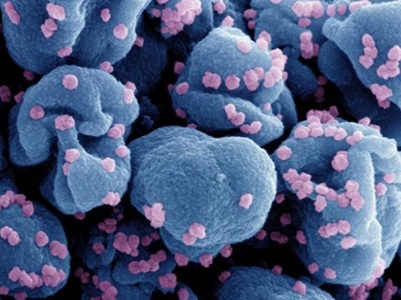
Colorized scanning electron micrograph of a cell (blue) infected with SARS-CoV-2 virus particles (pink), isolated from a patient sample. Credit: National Institute of Allergy and Infectious Diseases (NIAID)
In new research, scientists at the University of California San Diego really took the phrase “what’s old is new again” to heart. To combat mutated, resistant variants of SARS-CoV-2 that are spreading, researchers looked to old molecules rather than searching for antiviral candidates from scratch.
SARS-CoV-2 depends on an enzyme called Mpro to replicate in host cells. Mpro is structurally similar to another enzyme called cruzain, which allows the parasite that causes Chagas disease to thrive in human cells. Given the similarities, the researchers reasoned that one or more of previously approved anti-cruzain compounds might block SARS-CoV-2.
The team screened 141 previously synthesized compounds that had originally been designed between 1997 and 2012 to inhibit cruzain. Five of the 141 molecules stood out for their ability to strongly inhibit Mpro.
Subsequent testing of 5b demonstrated the strongest inhibition of Mpro, even at extremely low concentrations. 5a and 5b were also effective against the enzymes that allow SARS‑CoV and MERS‑CoV—two viruses closely related to SARS-CoV-2—to replicate. Both versions exhibited very high selectivity for the viral enzymes without significantly affecting human enzymes involved in normal cell function, an important consideration when developing drugs with fewer side effects.
In addition, computer simulations revealed that compounds 5a and 5b bind to Mpro firmly enough to stop it from working, but not permanently, a property associated with potent yet safer drugs. Overall, the researchers say the molecules demonstrated low toxicity in mammalian cells, reinforcing their potential as early‑stage drug candidates for further study.
Data from UCSD