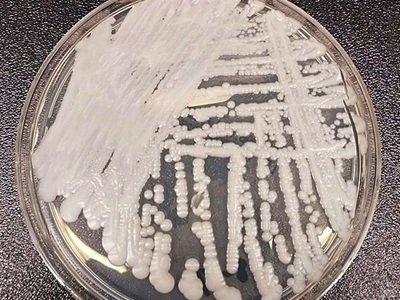
A strain of Candida auris cultured in a petri dish at a CDC laboratory. Credit: Shawn Lockhart/CDC
A new study shows how the multi-resistant fungus Candida auris utilizes carbon dioxide to survive on the skin and become resistant to antifungal therapies.
Due to its pronounced adhesion properties, C. auris grows predominantly on the skin surface. For immunocompromised patients, colonization and infections are life-threatening, with mortality rates of up to 70 percent.
Using multi-omics analyses, researchers at the Medical University of Vienna identified a key enzyme—carbonic anhydrase—that enables the fungus to convert small amounts of CO₂ into usable metabolic products. This allows Candida auris to generate mitochondrial energy and compensate for both nutrient deficiency and therapeutic stress.
Of particular impact is the discovery that specific inhibition of mitochondrial cytochrome bc1 significantly weakens the energy metabolism of the fungus and increases the efficacy of amphotericin B (AMB), one of the few remaining and clinically most important antifungal agents for the treatment of Candida auris infections.
A newly identified chemical compound that specifically inhibits cytochrome bc1 could form the basis for future antifungal drugs.
The study also shows that Candida auris cooperates with certain urease-positive bacteria in the skin microbiome. These bacteria break down urea into CO₂—an additional source of energy for the fungus. This association could be a factor in the high colonization and transmission rates in hospitals. From an infection prevention perspective, this opens up new avenues of approach: inhibiting bacterial urease activity could reduce local CO₂ concentrations and make colonization more difficult.
Data from Medical University of Vienna