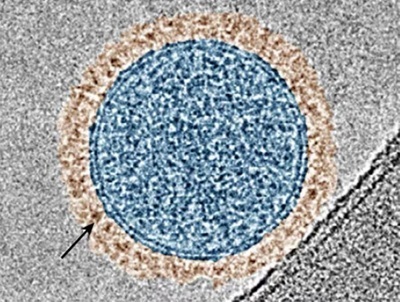
A color-enhanced microscope image showing an exosome (in blue) with PD-1 proteins on its surface (in brown). The black arrow points to the ring of PD-1. Credit: Cheng Lab/Columbia Engineering
A significant proportion of cancer patients fail to respond to checkpoint inhibitor therapy, with non-response rates in melanoma approaching 40%.
Now, researchers at Columbia Engineering have developed an inhalable nanotherapy that can activate the immune system against cancers resistant to current checkpoint inhibitor therapies. BEAT (Bispecific Exosome Activator of T Cells) uses tiny bubbles, or exosomes, to directly deliver therapeutic proteins to the lungs—the most common non-skin metastasis site in melanoma.
In the new study, published in Nature Biotechnology, researchers created an exosome system that co-displays two therapeutic proteins to treat lung metastases. One protein blocks the PD-1/PD-L1 immune checkpoint pathway, a process that has been shown to boost the immune response against melanoma cells and shrink tumors. The other protein blocks the Wnt/β-catenin signaling pathway that drives immune exclusion in tumors, a phenomenon where immune cells are unable to infiltrate tumor tissues.
The results demonstrated that, compared with a systemically delivered approach with antibodies targeting the same pathways, inhaled BEAT showed better retention in the lungs and dramatically suppressed tumor growth to a larger extent.
“By co-displaying them on a single exosome, BEAT can ‘reprogram’ the tumor microenvironment and recruit cancer-killing T cells directly to the tumor site,” said Ke Cheng, professor of biomedical engineering at Columbia Engineering. “In mouse models of metastatic melanoma resistant to checkpoint inhibitors, inhaled BEAT completely reversed immune resistance, outperforming dual antibodies and showing minimal side effects.”
For next steps, Cheng and his colleagues aim to validate BEAT in larger animal models and across different cancer types. They also plan to conduct formal toxicology and pharmacokinetic studies to prepare for early-phase clinical trials.
Data from Columbia University