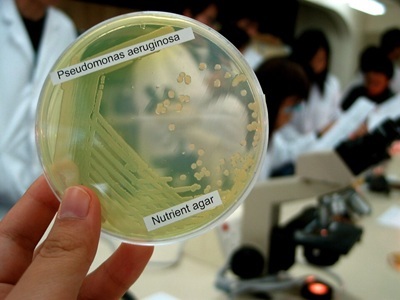
English: The bacteria Pseudomonas aeruginosa on a lab plate. Credit: Denise Chan
During the COVID-19 pandemic, researchers were exploring the idea of using blue or UV light to kill the virus in public places. Around the same time, a team of researchers at the University of Chicago discovered that far-red light prevents the formation of biofilms by the human pathogen Pseudomonas aeruginosa.
Pseudomonas aeruginosa, an antibiotic-resistant bacterium, is normally found in the soil and water and is known to cause difficult to treat infections in hospitalized patients, especially those with weakened immune systems, lung diseases or large wounds.
In a new study published recently in Nature Communications, the same team discovered that a small protein triggers a photo-sensitive cascade that activates genes to suppress biofilms and virulence in Pseudomonas aeruginosa. This photo-sensing system is also present in other Pseudomonas bacteria, suggesting that it has more undiscovered functions.
For the study, the researchers attached a Luciferase reporter gene that produces its own light to a promoter for the genes that produce virulence factors. When they exposed the bacteria to far-red light, the reporter was not activated, meaning those genes were not expressed. They also engineered a version of the bacterium with mutations to disrupt the photo-sensing cascade and saw it produced more of the virulence factors.
During those screens, Dimitrios Manias, lead author of the study, identified a new, unknown gene that was being expressed when far-red light shone on bacteria. This gene encodes for a small protein called DimA located in between the inner and outer layers of the bacterium’s cell membrane, which appears to kick off a chain of protein processing that activates the transcription factors that ultimately suppress biofilms and virulence.
“Now we have a positive regulator of the system, so you can imagine a situation where we could artificially over express this small protein and see if we can prevent biofilm formation,” said Sampriti Mukherjee, assistant professor of molecular genetics and gell biology.
The team also found several unknown genes that were activated by light, which suggest that this photo-sensing cascade could have other uses in Pseudomonas species. Mukherjee hypothesized that it could be a mechanism for controlling responses to naturally varying light. Her team wants to learn more about the role of the small protein and the many other genes activated by light.
Data from University of Chicago