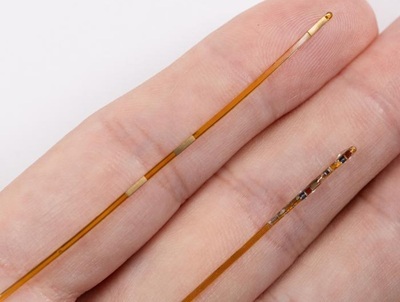
New probe is just three times the width of the diameter of a single hair. Credit: John A. Rogers/Northwestern University
Researchers have developed a tiny—just three times the width of a single hair—device that can continuously track multiple vital signs of a fetus while still in the uterus. The probe can be gently inserted through the same narrow port already used in fetal surgeries, reducing the risk for both baby and mom.
In some cases, surgeons need to perform fetal surgery to correct life-altering or life-threatening congenital conditions before birth such as spina bifida, diaphragmatic hernias, urinary tract obstructions, fetal tumors or twin-to-twin transfusion syndrome.
Currently, doctors primarily rely on intermittent measurements of fetal heart rate using ultrasound imaging from outside the pregnant person’s body. However, this does not give the entire picture, as information on other vital signs is missing.
“Our ability to monitor the fetus hasn’t changed in 40 years. The tools just haven’t been there,” said device co-developer Aimen Shaaban, a fetal surgeon at Ann & Robert H. Lurie Children’s Hospital of Chicago. “This probe provides multiparameter continuous monitoring of the fetus, enabling corrective adjustments at a very early stage to ensure fetal well-being throughout the procedure and avoiding any instability.”
Indeed, the probe reliably tracks heart rate, heart rate variability, blood oxygen levels and temperature.
Device design
The slender, filament-like probe is made from soft, flexible materials that can operate safely and gently inside the uterus. With a width just three times the diameter of a single hair, the probe is slim enough to pass through a standard tube already used during fetoscopic surgery, requiring no additional incisions.
Once inside the uterus, soft robotic actuators enable the surgeon to guide and position the probe with precision. To ensure the probe stays in place, the research team designed a tiny, inflatable balloon-like cushion. The built-in cushion gently expands to hold the probe in stable contact with the fetus.
To optimize the probe’s shape, motion and contact forces, researchers used computational modeling to guide the device’s mechanical design.
“The device needs to gently press onto the tissue to form the kind of coupling needed to measure vital signs,” said device co-developer John A. Rogers, a Northwestern bioelectronics pioneer. “Miniaturized balloons integrated onto the probe enable this coupling in a soft, minimally invasive manner. Our designs also use a similar mechanism to allow the filament to bend or twist, so that surgeons can robotically position it to a desired location.”
The team also integrated multiple miniature sensors into the probe to simultaneously measure fetal heart rate, blood oxygen saturation and temperature. The device wirelessly transmits data to a monitor outside the body, providing surgeons with real-time feedback throughout the procedure.
Safer and more comfortable
By enabling continuous monitoring of multiple vital signs without additional or invasive procedures, the new probe could help surgeons intervene earlier or pause if a fetus shows signs of distress. It could also help give parents and caregivers more peace of mind during anxiety-inducing surgeries.
“When a pregnant mom needs a fetal operation, she places a lot of trust in her doctors to make sure that it is safe,” said Shaaban. “If we could give her more confidence that her baby will do well, that’s better for everybody. Anything we can do to make operations safer for mom and baby is a huge win.”
A paper about the device has been published in Nature Biomedical Engineering.