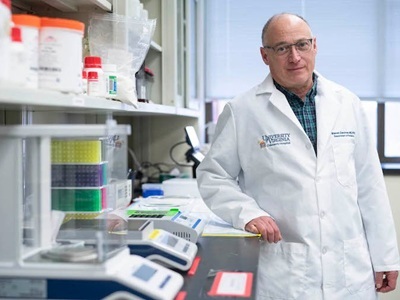
UVA Health’s Steven Zeichner, MD, PhD, has developed a platform to create vaccines quickly and inexpensively to respond more nimbly to infectious-disease outbreaks. Credit: UVA
University of Virginia Health scientists are reporting promising success as they pioneer a new way to create vaccines more quickly, nimbly and inexpensively than ever before.
Steven Zeichner, MD, PhD, is optimizing a vaccine-development platform he has created to accelerate how quickly life-saving vaccines can be designed and deployed during infectious-disease outbreaks, such as the COVID-19 pandemic.
The innovative approach first identifies a part of an infectious organism that could be a good candidate for a vaccine, then designs a vaccine based on that target, incorporating features that enhance and shape a person or animal’s immune response. After verifying the design has the desired features using AlphaFold AI protein structure prediction software, instructions are sent to a synthetic DNA company that synthesizes DNA to tell a bacteria how to make the vaccine.
The company puts this DNA into a plasmid, which is then put into special bacteria. The bacteria are grown and inactivated to make the vaccine. This process is much simpler than the processes used to make mRNA and many other vaccines.
Zeichner’s latest work, published in Vaccines, serves as proof-of-concept, demonstrating that the platform can effectively produce vaccines that are highly immunogenic. The researchers also showed that the platform can enhance the immunogenicity of a vaccine test target dramatically—in the best case, by approximately eight times compared with an initial test vaccine.
Zeichner’s vaccines would cost less than $1 per dose, ensuring availability even in countries with limited resources. Further, the vaccines would be shelf-stable, another critical component for those in remote and developing areas.
“Vaccines need to be safe and effective, but it is also important that we can make vaccines against new threats very quickly so we can respond to new pandemics,” said Zeichner. “Goverments and others have stated that a new vaccine for a pandemic threat should be able to be made in 100 days, but we think our platform can make a new vaccine for testing in 21 days.”
Data from University of Virginia