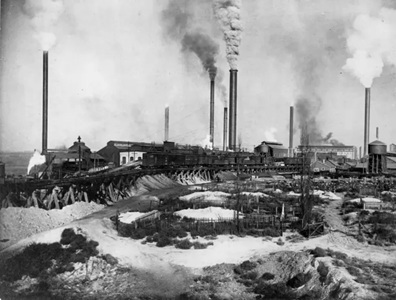
The U.S. Mining and Smelting Co. plant in Midvale, Utah, 1906. Credit: Photo used by permission, Utah Historical Society
Prior to the establishment of the Environmental Protection Agency in 1970, Americans lived in communities awash with lead from industrial sources, paint, water supply pipes and, most significantly, tailpipe emissions. Environmental lead levels reduced in the years since—and the proof is in your hair.
An analysis of hair samples conducted by University of Utah scientists show precipitous reductions in lead levels since 1916.
For the new study, published in PNAS, the researchers used mass spectrometry techniques to analyze hair samples from 48 recruited Utahns, offering a window into lead levels along Utah’s populous Wasatch Front, which historically experienced heavy lead emissions from industrial sources. The surface of the hair is unique in that some elements, like lead, accumulate at the surface.
“That makes it easier because lead is not lost over time,” said study author Diego Fernandez, professor at the University of Utah. “Because mass spectrometry is very sensitive, we can do the analysis with just one hair strand, though we cannot tell where the lead is in the hair. It's probably in the surface mostly, but it could also be coming from the blood—if that hair was synthesized when there was high lead in the blood.”
Blood would provide a better exposure assessment, but hair is far easier to collect and preserve, and more importantly, it offers clues to long-ago exposures for a person who is now grown up or even deceased.
Indeed, the team’s findings run parallel to the reductions of lead in gasoline following the EPA’s establishment by then-President Richard Nixon.
Data from University of Utah