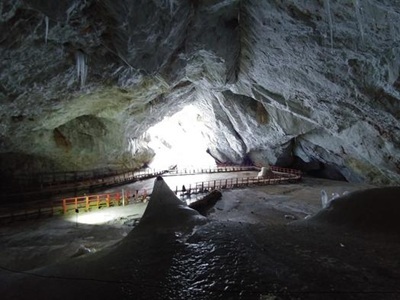
The Scarisoara Ice Cave in Romania where Psychrobacter SC65A.3 was found within drilled ice fragments. Credit: Paun V.I.
What would 5,000-year-old bacteria that has been frozen in an ancient underground ice cave know about today’s modern, human-exacerbated antibiotic resistance crisis? As it turns out—a lot. And researchers say that could be a really bad or a really good thing.
Scientists in Romania recently isolated the Psychrobacter SC65A.3 bacterial strain from a 5,000-year-old layer of ice in the underground Scarisoara Ice Cave. Testing the antibiotic resistance profiles of the strain, they found it shows resistance to multiple modern antibiotics and carries over 100 resistance-related genes.
“If melting ice releases these microbes, these genes could spread to modern bacteria, adding to the global challenge of antibiotic resistance,” said study author Cristina Purcarea, a senior scientist at the Institute of Biology Bucharest of the Romanian Academy. “On the other hand, they produce unique enzymes and antimicrobial compounds that could inspire new antibiotics, industrial enzymes, and other biotechnological innovations.”
An untapped source
As described in their study, published in Frontiers in Microbiology, Purcarea and team drilled a 25-meter ice core from an area of the Scarisoara Ice Cave known as the Great Hall, representing a 13,000-year timeline. They then took these ice fragments back to the lab for genomic sequencing.
It’s here they isolated and identified Psychrobacter SC65A.3 from the ice fragments—a strain of the genus Psychrobacter, which are bacteria adapted to cold environments. Some of these species are already known to cause infections in humans or animals.
In the genome, the researchers found almost 600 genes with unknown functions— suggesting a yet untapped source for discovering novel biological mechanisms.
Ancient genome, modern problem
The researchers then tested the SC65A strain for resistance against 28 antibiotics from 10 classes that are commonly used to treat bacterial infections.
Psychrobacter SC65A.3 showed resistance to 10 modern antibiotics, including rifampicin, vancomycin, ciprofloxacin, trimethoprim, clindamycin and metronidazole. These antibiotics are routinely used to treat tuberculosis and UTIs, as well as infections of the lung, skin, blood and reproductive system.
At the same time, the strain’s genome revealed 11 genes that can inhibit the growth of several major antibiotic-resistant superbugs. SC65A.3 also showed important enzymatic activities with biotechnological potential.
The researchers say SC65A.3’s resistance profile suggests that strains capable of surviving in cold environments could act as reservoirs of resistance genes, which are specific DNA sequences that help them survive exposure to drugs.
“[The] potential to kill or stop the growth of other bacteria, fungi and viruses is becoming ever more important in a world where antibiotic resistance is a growing concern,” said Purcarea. “Studying microbes such as Psychrobacter SC65A.3 and uncovering their potential highlights the important role the natural environment played in the spread and evolution of antibiotic resistance, long before modern antibiotics were ever used. These ancient bacteria are essential for science and medicine.”