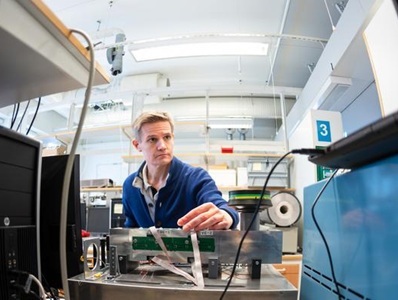
Jens Eriksson, associate professor at Linköping University, in his laboratory. Credit: Olov Planthaber
Using machine learning, researchers have pioneered an electronic nose that can “smell” early signs of ovarian cancer in the blood. The method is so precise the researchers say it could eventually be used to find many different cancers.
“We’re trying to mimic the mammalian sense of smell artificially. We’ve now developed an algorithm that can distinguish ovarian cancer from endometrial cancer and healthy control groups, using data from an electronic nose,” says Donatella Puglisi, associate professor at Linköping University (Sweden).
Current healthcare cancer screening by blood test involves searching for a number of biomarkers that are unique to the form of cancer suspected. However, test analysis is slow and often not very accurate.
The method developed by Linköping University researchers does not need the identification of a specific biomarker. Instead, the electronic nose uses its 32 sensors to pick up a large variety of volatile substances emitted from blood plasma samples.
The data are then analyzed using advanced machine-learning models to identify patterns specific to ovarian cancer. The models are trained on known samples from a biobank, resulting in a 97 percent accuracy.
“This study is a pilot, but we hope it will be used as part of cancer screening within three years. Right now, we’ve focused on detecting cancer, but the applications are endless,” says says Jens Eriksson, associate professor at Linköping and CTO at VOC Diagnostics AB, the company developing the electronic nose.
Data from Linköping University