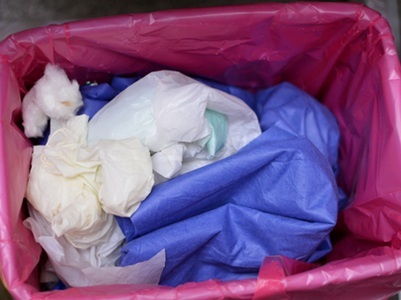
How many gloves does your laboratory dispose of every day? Even if you work at a smaller laboratory, the gloves add up.
For example, a typical laboratory worker can use over 1,500 gloves per year, assuming they change gloves multiple times daily. Smaller research teams of around 7–10 people may go through a case of gloves (~1,000 gloves) every 2-3 months, while larger, high-volume laboratories use hundreds of thousands of gloves annually. In hospitals, where usage is higher, glove consumption can exceed 50,000 per day in larger facilities.
While a plastic water bottle can be easily recycled, other plastic materials are problematic because they cannot be reused in the same way. Therefore, they often end up being burned, which is the case for rubber gloves.
Hoping to reduce this amount of waste, Simon Kildahl, a postdoc at Aarhus University (Denmark), has taken a research step toward a greener way to recycle lab and medical gloves.
In his new study, published in CHEM, Kildahl and colleagues demonstrate how they can transform waste rubber into a CO2 adsorbent.
The group has previously succeeded in recycling materials such as polyurethane foam from mattresses, as well as epoxy and glass fibers from wind turbine blades—materials that were previously considered impossible to recycle. Now, they have succeeded with rubber gloves.
“We shred the rubber glove into small pieces,” explained Kildahl. “It then reacts with a ruthenium-based catalyst and hydrogen gas, after which it can capture CO2 from simulated flue gas. In the real world, this could potentially take place at a power plant.”
When heated, the rubber product regenerated and then the CO2 again, allowing the gas to be sent for underground storage or used in Power-to-X. Simultaneously, the material is refreshed and ready to capture new CO2.
While materials for CO2 capture already exist, Kildahl’s approach stands out by using waste material that would otherwise be burned or landfilled.
These experiments bring the world a step closer to aligning with the UN Intergovernmental Panel on Climate Change goal of removing 5 to 16 billion tons of CO2 from the atmosphere annually by 2050. To reach these goals, CO2 must be captured from biomass incineration plants or directly from the air. The problem is that current methods require a scale-up of oil-based production, which inherently reduces the overall climate benefit.
“That is why it is smart to utilize a waste material available in such large quantities, rather than extracting more oil from the ground,” said Kildahl points out. “With the rubber glove, we can create a CO2 capture material where almost every atom in the product comes from waste, except for a small amount of hydrogen, which can ideally be obtained from water via Power-to-X.”
Currently, the new method is still at the laboratory stage, although a proof-of-concept has been completed. On a scale from early idea (TRL 1) to fully implemented commercial technology (TRL 9), Kildahl says the research is currently at a level 3 or 4.
“It is entirely possible that we can reach level 5 or 6 in the near future if we can improve the scalability and the economy of the reaction, as well as enhance certain performance parameters for CO2 capture with these materials," the researcher concludes.