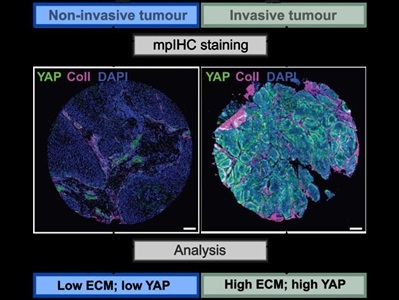
An outline of one of the researchers’ approaches to understanding the properties of human laryngeal tumors. Here, patient tumor samples were classified into different groups and stained multiple times for different combinations of proteins (mpIHC). Green: YAP, stains the cancer cells; Blue: DAPI, stains the nuclei; Red: collagen (coll), shows the connective tissue (ECM) surrounding the cancer cells. The researchers found that more invasive tumors had higher levels of YAP and a stiffer connective tissue (ECM). Credit: Turku Bioscience Centre
As laryngeal cancer progresses, movement of the vocal cords weakens and eventually stops. Now, researchers have, for the first time, discovered that restoring cellular vibration reduces the aggressiveness of advanced vocal cord cancer.
Researchers have long known that increased tissue stiffness promotes cancer malignancy in non-moving tissues such as breast, liver, and pancreatic cancers, because cells sense and respond to the physical properties of their environment. The sensitivity of cells to external forces led researchers to take an interest in laryngeal cancer, which develops in constantly moving tissue.
“We wondered whether ‘movement could be medicine’ and whether tissue stiffening and immobilization contribute to cancer development,” said professor Johanna Ivaska, director of the Barrier Force Centre of Excellence.
The team set up a bioreactor in which cells were grown on a vibrating membrane placed on top of a loudspeaker. The study’s lead author, Jasmin Kaivola, who recently completed her doctoral degree at the University of Turku in Finland, came up with the idea of connecting an old mobile phone to the device to play sounds and music, and the experiments began.
The researchers’ predictions proved correct: exposing cancer cells to vibration-mimicking vocal cord movement reduced their malignancy. One of the observed changes was a decrease in a protein called YAP in the cells.
Using samples of early-stage and advanced laryngeal cancer collected from approximately 200 Finnish patients, the researchers found that elevated expression of proteins that increase tissue stiffness enhanced YAP activity and predicted mortality. In an experimental cancer model, the researchers discovered that the cancer was sensitive to a targeted drug under development that inhibits YAP protein activity.
Data from University of Turku