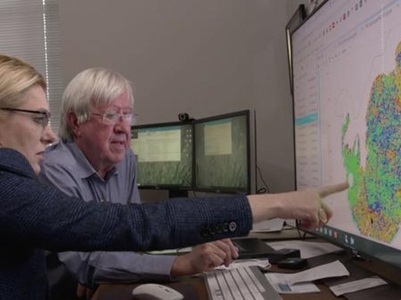
Janis Taube and Alexander Szalay. Credit: Johns Hopkins Kimmel Cancer Center
Researchers have created a novel database structure that allows investigators anywhere to more easily study multiple types of cancer data in one setting.
Typically in oncology, each patient’s course includes multiple visits, treatments and outcome measures. To identify and characterize biomarkers, these parameters need to be linked to multiple tests and assessments, including blood-based laboratory values, tissue-based pathology, radiography, genomic studies and more.
“What this structure does is allow me to ask questions across all of this data that’s already been gathered, and across tumor types, and combine it all together in the context of the longitudinal patient experience,” explains Janis Taube, M.D., director of the Division of Dermatopathology and co-director of the Tumor Microenvironment Laboratory at the Bloomberg-Kimmel Institute for Cancer Immunotherapy.
Called AstroID, the resource organizes clinical and correlating blood and tissue specimen information in six tiers, including information from the patient (deidentified to protect privacy); diagnosis; clinical events such as treatment or a blood draw; specimens such as material from a biopsy or serology; and then details about how those are processed by the lab into tissue blocks and vials, down to individual slides or aliquots.
The structure, built in a commercial web-based application called REDCap, can be subsequently scaled to accommodate thousands of patients and the spatial characterization of billions of cancer cells.
It had been painstaking for researchers to manually enter data, so cancer studies typically were designed around relatively small cohorts.
“What we are trying to do is to scale out so we can handle patients on the order of hundreds or thousands of patients in a study,” said Alexander Szalay, professor in the Department of Computer Science at Johns Hopkins University.
The idea is to organize all the medical and specimen data into multiple hierarchical tiers, which then can be easily translated to a query-oriented platform based on a large relational database.
Researchers at Johns Hopkins Medicine have now deployed this structure in their laboratories for 16 different patient groups with multiple tumor types, and they have over 1 billion cells spatially mapped and tagged with clinical information from patient experiences.
While the team is using the platform for cancer studies right now, the structure could be adapted to characterize longitudinal biospecimens from any disease process, they said.
Data from Johns Hopkins Medicine