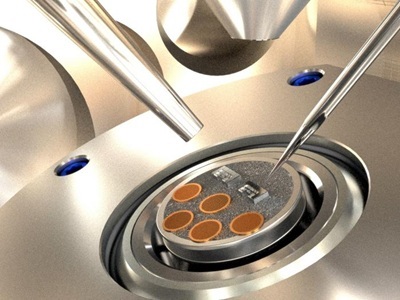
Close-up view of the top of the sample transfer box (top door open), showing that the lithium dendrite was transferred using a micromanipulator tip (a sharp silver needle) from the brown copper transmission electron microscopy grids to the Rice micromechanical devices (silver blocks), ready for subsequent testing and characterization. Credit: Lou Group/Rice University
For the first time, scientists have observed how lithium dendrites—tiny crystalline thorns that grow off lithium-ion battery anodes during charging—sprout inside the batteries and cause them to fail. Dendrites' branches can penetrate into a lithium cell's electrolyte; if dendrites extend from the negatively charged anode to the positively charged cathode—they short out the battery.
For the new study, researchers across universities in the U.S. and Singapore harvested dendrites from working batteries to test their mechanical strength. Using high-resolution electron microscopy, they observed the deformation of individual dendrites under controlled stress in real time.
With the help of a purpose-designed, specialized air-free chamber and precise nanomechanical probes, the research team was able to achieve direct, individual measurements of the fragile structures. These unprecedented measurements provide important insights into how lithium dendrites respond to the physical stresses within a battery cell.
“Contrary to common assumptions, we found that lithium dendrites exhibit unexpectedly high strength and brittle behavior under mechanical stress,” said Jun Lou, professor of materials science and nanoengineering at Rice and co-corresponding author on the study.
According to the study results, published in Science, lithium dendrites are rigid, microscopic structures resembling nanosized needles or whiskers. Inside the battery cell, they get enveloped in a minute layer of solid electrolyte interphase as they form. This coating enhances their structural rigidity, explaining how they can pierce separators or even stiff solid electrolytes. This same encasement prevents the dendrites’ lithium core from deforming plastically; as a result, the “lithium icicles” are prone to snapping under stress, leading to the formation of isolated “dead lithium” fragments.
“This work provides a potential explanation for why certain protective layers fail to arrest lithium dendrite growth,” said Xing Liu, an assistant professor at New Jersey Institute of Technology and co-first author on the study. “It is a useful mechanical framework that could help the research community develop more effective strategies for improving the safety and reliability of high-energy storage systems, including those for electric vehicles and renewable energy grids.”
Data from Rice University