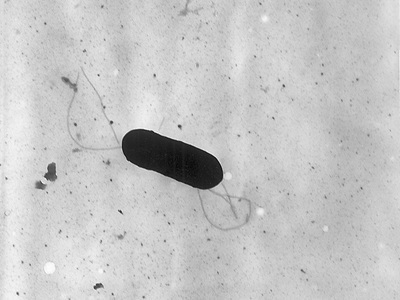
Electron micrograph of a flagellated Listeria monocytogenes bacterium. n the United States, an estimated 2,500 persons become seriously ill with listeriosis each year. Of these, 500 die. Credit: Elizabeth White/CDC
Would you eat deli meat that has tested positive for the bacterium Listeria monocytogenes? Of course not. But what if a test confirmed the bacteria was present at a very low level unlikely to cause harm or disease? Would that change your mind?
The authors of a new study published in Frontiers in Science argue that it should, as the world needs to better balance food safety and sustainability. The multi-national team says excessive food safety measures and ultra-sensitive tests result in edible food ultimately being thrown away.
“Although the public expects food to be completely safe, there will always be some risk of foodborne illness. Zero risk doesn’t exist, and we shouldn’t be aiming for that either. Just as we don’t limit highway speeds to 10 miles per hour to minimize road deaths, we need to take a balanced approach that considers possible negative consequences of extreme food safety measures,” said lead author Martin Wiedmann, professor or food safety and food science at Cornell University.
In their paper, Wiedmann and colleagues conclude that food systems would be more sustainable—while continuing to protect public health—if “zero-detection” expectations are replaced with evidence-based targets for “sufficiently safe” food.
The current climate is driven by an emphasis on hazard-based assessments where regulations focus on detecting pathogens, regardless of the threat to consumers. The researchers argue that the food system should move toward more flexible risk-based approaches, which assess the probabilities of harms and adjust the safety measures accordingly.
The listeria situation referenced earlier is the perfect example. The current regulations and purchasing standards rely heavily on detecting a pathogen, sometimes treating any detection as unacceptable without fully considering dose, exposure, the food’s ability to support microbial growth, or who is most at risk.
These alarms can result from ultra-sensitive tests detecting small amounts of microbes unlikely to cause disease in humans. In some cases, the concerns may come from bacteria that are not harmful themselves, but are an indirect indicator of contamination.
Throwing away such food reduces the available food supply and wastes resources. Similarly, recalling food products from consumers can damage consumer trust, pushing people away from otherwise healthy products.
“A tremendous amount of food is wasted that would have been sufficiently safe to eat,” said study co-author Sophia Johler, professor at Ludwig Maximilian University (Germany). “Too often, trade-offs such as environmental or economic costs are only considered after a traditional microbial risk assessment. We cannot afford to carry on like this at a time when we desperately need to reduce our impact on the planet and assure not only food safety but food security.”
The researchers say computational tools that incorporate vast amounts of information across the food production system could help with establishing acceptable risks. However, an acknowledged challenge is how to prioritize different hazards. For example, in the U.S., norovirus causes thousands of times more cases than Listeria monocytogenes, yet Listeria monocytogenes causes more deaths per year.
“Specialists across social sciences, economics, and life sciences must work together to establish values that align with consumers’ priorities,” said Wiedmann. “Together with advanced models that build on geographic information, AI, and genomics, we can assess, manage and communicate risks far more accurately.”