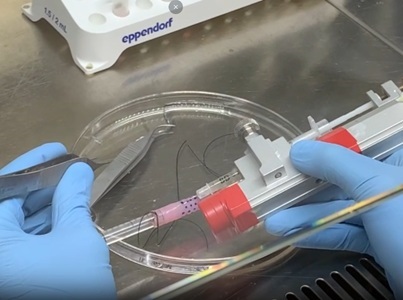
The lab‑grown oesophagus. Credit: GOSH
Scientists have created the first lab‑grown oesophagus—the food pipe—that can safely replace a full section of the organ and restore normal function, including swallowing, in a growing animal without the need for immunosuppression. Previous studies have shown parts of this technology, but this is the first time that the full process has been completed with such success.
For the study, published in Nature Biotechnology, researchers first created a scaffold to act as a tube-shaped base for the new organ. Through a process called decellularisation, the donor tissue was carefully stripped of all the pig cells, while keeping the underlying support structure intact.
Next, the scaffold was repopulated with a recipient pig’s muscle cells, The graft was then placed in a bioreactor for one week. In all, the process took two months to complete—a timeline compatible with current standard treatment of long-gap oesophageal atresia (LGOA).
All eight animals survived the critical first 30 days after transplant. By the 6-month mark, the lab-grown grafts had developed functional muscle, nerves and blood vessels. This allowed the transplanted oesophagus to contract and move food like a native food pipe. The transplanted animals could eat normally and grow at a healthy rate.
For the first time ever, the research team was able to map the genes in the structure of the implanted tissue to show that the genes turned on in the new oesophagus were in line with what would be expected in “natural” tissue. There was also a progressive regeneration of normal oesophageal structures, with a barrier layer, muscle, nerves and blood vessels needed for a functioning oesophagus. Immunosuppression was not needed as the implant was developed using the recipient’s cells and the tissue grew with the animals.
Children born with LGOA cannot survive without surgery, but the gap is often too large to close immediately after birth. Instead, babies with LGOA typically require a feeding tube placed directly into their stomach. The current surgical options are complex and invasive. While many children achieve good outcomes, better options with reduced risk of complications are sorely needed for these babies.
If this technology is adapted for use in humans, different sizes of scaffold could be stored ready to be developed and personalized for newborns and children of varying sizes and age. Biopsy cells could be taken from the child when the feeding tube is placed and incorporated into the scaffold, creating a personalized graft that would grow with the child and not require immunosuppressants.
Data from Great Ormond Street Hospital for Children